

Unsuitable Goods After Shipment? Don’t Let Solar Light Shipping Cost Turn Into Rework Cost

Importing all-in-one solar street lights already comes with high ocean freight costs. Many buyers only focus on the ex-factory price and basic China-to-port shipping fee, ignoring huge hidden risks.
If the goods arrive at the destination and turn out to be unsuitable — wrong model, insufficient brightness, mismatched accessories, damaged packaging, or unfit for on-site installation — the loss is no longer limited to product issues. Instead, your overall shipping cost, time cost, and project delivery progress will all be greatly magnified.
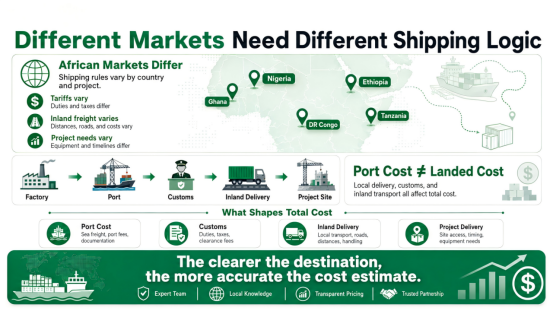
This is especially critical for projects in Tanzania, Nigeria, Ethiopia, Ghana, and DRC. Procurement cannot only calculate freight from China to the port. You must also take destination port fees, customs clearance costs, inland transportation, and final project site delivery into account.
Once supplementary shipment, product replacement or on-site rework is required after arrival, the extra cost will be extremely high.
Therefore, when ocean freight is expensive, random product selection is never cost-effective. The real way to save cost is not simply squeezing the unit price, but selecting the correct model, configuration, packaging and quantity in one go.
1. Different African Markets Require Different Cost Assessment Logic
Shipping conditions, port fees, clearance regulations and inland logistics costs vary greatly across different African countries.
For destinations including Tanzania, Nigeria, Ghana, DRC and Ethiopia, the overall landed cost structure is completely different.
Some destinations are close to seaports with convenient local delivery after port arrival. Some projects are located in inland cities with much higher secondary transportation costs. Some rural roads, mining areas, farms and remote construction sites require additional final-mile delivery budgets. Some countries have strict local clearance rules and miscellaneous fees. Without prior confirmation, your budget will easily exceed expectations.
As a result, buyers should never judge costs only based on China-to-port freight. The true cost refers to the total expense until goods reach the final usage site.
For project-based orders, calculating only port arrival cost without considering on-site delivery will inevitably lead to budget shortages in later construction stages.
The safest procurement practice is to clarify the delivery standard in advance: • Port delivery • Warehouse delivery • Distributor store delivery • Exact project site delivery • Whether additional inland transportation is needed • Whether remote area distribution is involvedThe clearer your destination positioning, the more accurate your overall cost judgment will be.
#AllInOneSolarLight #SolarStreetLight #AfricanSolarProjects #ImportCost #ShippingLogistics #SolarProcurement