

Solar Lighting Upgrade Project of Unity Park, Addis Ababa, Ethiopia

Project Overview
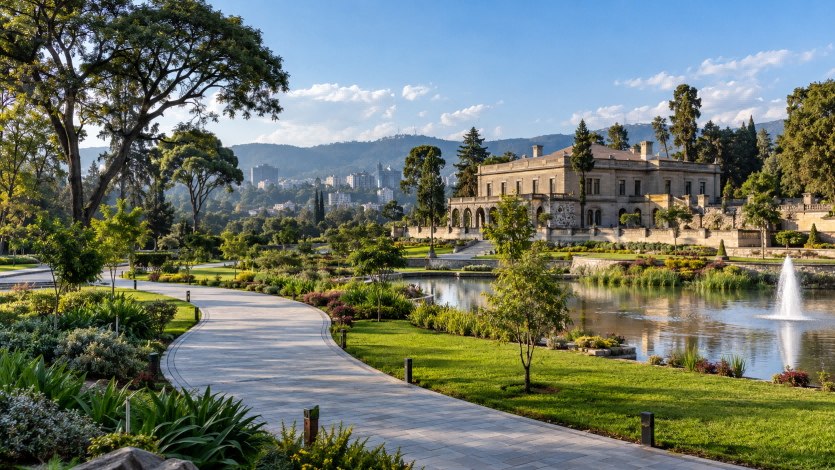
This project is located in Addis Ababa, the capital of Ethiopia. Unity Park is Ethiopia’s most representative urban public park and national landmark, situated within the National Palace precinct. It integrates urban greenery, pedestrian paths, landscaped water features, historic buildings and public leisure spaces, serving residents, foreign guests and urban public events. The park is rich in natural vegetation, with winding walkways and numerous landscape nodes.
Before the upgrade, parts of the park relied on traditional mains lighting with complex cabling. Some forest paths and viewing platforms were under-lit, creating safety risks for night visitors. Mains power in parts of Addis Ababa is unreliable, and occasional outages affect evening park safety. The upgrade covers main walkways, forest paths, landscape plazas, viewing platforms and green nodes, with a total of about 2,100 linear meters of pedestrian paths and approximately 46,000㎡ of public park area.
The scheme adopts solar garden lights and solar wall lamps. Solar garden lights are placed along main walkways, forest paths and plaza edges to provide continuous soft functional lighting. Solar wall lamps are mounted on low walls around historic buildings, viewing platform side walls and pavilion columns to enhance night landscape layers and wayfinding. The system operates independently on solar energy without large-scale cabling under park greenery. Warm-white static lighting is used throughout, without coloured or dynamic effects, preserving the natural, quiet and comfortable night atmosphere of an urban park.
Local Environmental Conditions
Addis Ababa sits on the Ethiopian Highlands at about 2,350 meters altitude, with a mild and cool climate and annual average temperature of about 16–23°C, with noticeable day-night temperature variation. The wet season runs from June to September with concentrated short showers; the dry season brings strong sunshine and UV. Outdoor fixtures need good waterproofing to handle frequent showers and dry-season UV, plus reliable energy storage under cloudy conditions.
Unity Park is heavily used in the evening by strolling residents and tourists, with larger crowds on weekends and holidays, requiring a lighting system with stable endurance for safe night walking and landscape experience.

Project Objectives
- Increase average illuminance of main walkways, forest paths and landscape plazas from 7–12 lux before the upgrade to 18–24 lux, ensuring safe night-time park walking for residents and tourists.
- Achieve illuminance uniformity of ≥0.65 in main pedestrian areas, eliminating dark zones on forest paths, platform edges and landscape nodes.
- Deploy solar garden lights along main walkways, forest paths and plazas; install solar wall lamps on historic low walls, platform side walls and pavilion columns for park night wayfinding.
- Apply unified warm-white static lighting without coloured or dynamic effects, preserving the natural and quiet urban park night atmosphere.
- Keep the annual luminaire failure rate within ≤3%, adapting to Addis Ababa’s mild highland climate, rainy-season showers and dry-season UV.
- Eliminate large-scale green-area cabling, reducing maintenance workload by approximately 57%–61% and cutting long-term electricity and cable-maintenance costs.
- Support night-time strolling, sightseeing and security patrols, accommodating about 3,200 night-time users daily.

Project Outcomes
After completion, average illuminance of main walkways, forest paths and landscape plazas reached 21 lux, within the 18–24 lux target range. Illuminance uniformity in main pedestrian areas was 0.68, meeting the ≥0.65 requirement. Dark zones on forest paths, platform edges and landscape nodes were largely eliminated, making night walking paths clear and safe.
Solar garden lights were evenly arranged along main walkways and forest paths, forming a continuous pedestrian light belt. Solar wall lamps created soft landscape lighting along historic low walls, platform side walls and pavilion columns, enhancing the park’s natural night layers. Powered by dry-season sunshine with cloudy-day energy management, the system remained stable through rainy showers and highland temperature variation. The measured annual luminaire failure rate was 2.7%, below the 3% target. Maintenance workload decreased by approximately 59%, while large-scale green-area cabling and ongoing electricity costs were eliminated.
The night environment is natural, quiet and comfortable. Solar garden lights and solar wall lamps together form the night-time pedestrian lighting and landscape wayfinding system for Unity Park, ensuring safe evening visits while enhancing the night quality of this urban national landmark.
