

Avoid Rework & Reshipment Risks: Wrong Solar Light Configuration Wastes Your Full Shipping Investment

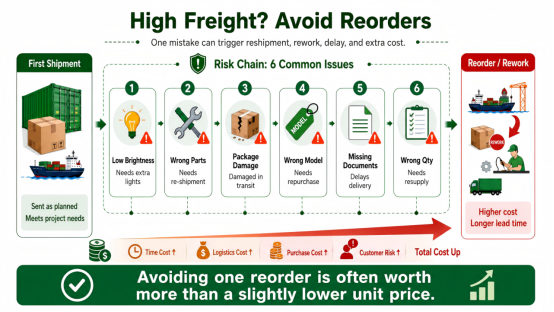
2. High Freight Makes Rework and Reshipment Extremely Costly
When ocean freight is expensive, the biggest profit loss is not the higher initial shipping cost, but repeated rework and supplementary shipments caused by on-site product mismatch after delivery.

Common post-shipment problems in African projects: • Insufficient brightness requiring additional light resupply • Mismatched installation accessories needing second shipment • Product damage caused by poor packaging • Wrong model selection leading to full re-purchase • Incomplete documents delaying project acceptance and delivery • Underestimated quantity requiring repeated shipment
For markets including Tanzania, Nigeria, Ethiopia, Ghana and DRC, secondary reshipments not only double logistics expenses, but also severely delay project progress and damage delivery credibility.
Therefore, full pre-order confirmation is far more valuable when shipping costs are high. Buyers must verify all project and product details in advance: • Exact product model and order quantity • Complete accessory list and installation method • Actual lighting demand and road width • Installation height and project scenarios • Local rainy season and high-temperature climate conditions
In long-term procurement, avoiding one single reshipment and rework is more profitable than squeezing a lower unit price at the beginning.
3. Mismatched Product Configuration Turns Shipping Cost Into Total Waste
No matter how low your freight cost is, it becomes completely meaningless if the product fails to adapt to local market and project conditions.
Typical configuration mismatch mistakes for African markets: • Deploying non-high-temperature-resistant lights in perennial strong sunlight areas • Applying low-brightness lights for wide road projects • Using small-capacity batteries for regions with long rainy seasons • Adopting unsuitable installation structures for on-site conditions • Using unstable packaging for long-distance ocean transportation
These problems seem like product defects, but they actually turn your entire shipping investment into waste. Once goods arrive overseas, returning goods, replacing products and resupplying accessories all come with high costs and long lead times, seriously affecting project progress.The higher the ocean freight, the more rigorous your product selection should be. Real cost saving relies on one-time accurate matching of model, configuration, packaging and quantity, ensuring direct sales and installation after arrival.

For all-in-one solar street light procurement, these key points must be confirmed in advance: • High-temperature resistance adaptability • Brightness matching local road width • Reasonable solar panel and battery matching • Sufficient rainy-season endurance performance • Site-adaptive installation method • Sea-worthy anti-collision and moisture-proof packaging • Complete technical documents and accessory sets
Unverified configuration details in the early stage will eventually turn your shipping cost into unnecessary rework cost.
Final Takeaway
Exporting all-in-one solar street lights to African markets cannot simply focus on unit price and first-stage ocean freight. The core of cost control is the full landed cost, including port fees, customs clearance charges, inland transportation, on-site delivery, and potential reshipment & rework risks.For Tanzania, Nigeria, Ethiopia, Ghana and DRC, different countries, ports and project locations lead to completely different logistics logic and final costs.
High shipping expenses force buyers to avoid model errors, accessory mismatch, packaging damage, insufficient brightness and poor rainy-season performance. The cost of post-arrival rework and replacement is far higher than the cost of pre-order verification.
Smart procurement confirms destination requirements, installation scenarios, road conditions, product configurations, packaging standards, container loading quantity and project demands in advance.The most effective cost-saving strategy is not lowering unit prices blindly, but achieving one-time perfect matching of products, packaging, logistics and project needs, so as to eliminate later reshipment and rework risks fundamentally.

#SolarStreetLight #AllInOneSolarLight #SolarProject #CostOptimization #AfricaInfrastructure #ProcurementTips