

Solar Street Light Failure in Rainy Seasons? Stop Choosing Configurations Based Only on Sunny-Day Performance

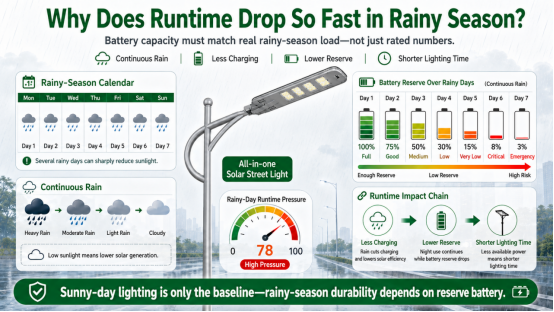
All-in-one solar street lights always deliver stable and bright lighting performance on sunny days. However, for regional markets with obvious long rainy seasons, sunny-day test results can no longer be the sole standard for product selection.
Markets such as Nigeria, Ghana, and the Democratic Republic of the Congo feature prominent rainy seasons with frequent consecutive overcast and rainy days. Tanzania and Ethiopia also have distinct seasonal sunlight variations throughout the year.The exact same all-in-one solar street light performs completely differently when installed in open roads with full sunlight compared to areas covered by tree shades, building shelters, or regions with prolonged rainy weather.
Therefore, when purchasing all-in-one solar street lights, do not merely refer to product power and nominal battery life advertised by suppliers. The core evaluation criteria lie in whether the product adapts to local rainy-season environments and whether the actual battery capacity can meet real on-site lighting demands.
Product configuration for rainy-season markets should never follow the standard of ordinary sunny environments. Selecting products purely based on ideal sunny-day parameters will inevitably lead to insufficient lighting hours and unstable performance during rainy seasons.
Before sourcing solar street lights for rainy-season regions, fully confirm the following practical on-site factors in advance: • Whether the average daily local sunlight is sufficient • Whether consecutive overcast days are common in rainy seasons • Whether the installation site is sheltered by trees or buildings • Lighting working mode: full-night constant brightness or timed dimming • Application scenarios: rural roads, courtyards, factory zones, or mining roads • Actual required daily lighting hours • Whether reserved power margin is needed for consecutive rainy days
Taking a 30W solar panel as an example, calculated based on 5 hours of effective sunlight on standard sunny days: 30W × 5h = 150Wh/day (theoretical daily power generation)
Nevertheless, the charging efficiency drops sharply during consecutive rainy days, only retaining 30% to 40% of sunny-day performance: 150Wh × 30% = 45Wh/day 150Wh × 40% = 60Wh/day
In short, a 30W solar panel that theoretically generates 150Wh of electricity per day on sunny days only produces 45Wh to 60Wh per day in continuous rainy weather. Without reasonable intelligent dimming and power-saving control, such limited power generation cannot support long-hour high-brightness lighting.
As a result, procurement for rainy-season markets should never focus only on sunny-day lighting effects. More importantly, verify whether the solar panel, battery, and controller have sufficient performance margin under low-sunlight rainy conditions.
#AllInOneSolarStreetLight #SolarLightProcurement #RainySeasonSolarPerformance #AfricanSolarProjects #OutdoorSolarLight #SolarConfiguration