

Solar Lighting Upgrade Project of Royal Palace Outer Compound, Phnom Penh, Cambodia

Project Overview
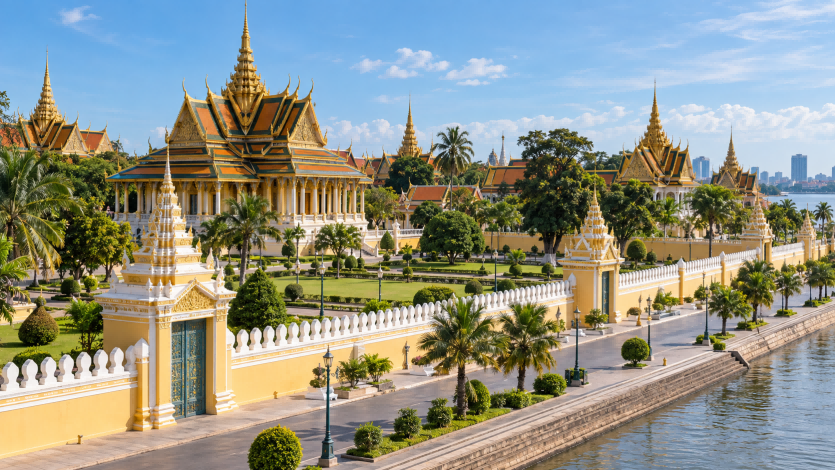
This project is located in Phnom Penh, the capital of Cambodia. The Royal Palace of Phnom Penh is a national historical and cultural landmark of Cambodia, featuring distinctive Khmer architecture and a royal garden atmosphere. The outer compound includes palace buildings, perimeter walls and corridors, landscape walkways, lawns, entrance plazas and waterside areas, serving national ceremonies, cultural visits, public leisure and urban image presentation.
Before the upgrade, parts of the outer walkways and nodes relied on aged mains lighting. Some waterside paths, wall corners and entrance plazas were under-lit, creating safety risks for night visitors. Phnom Penh has a long rainy season and high humidity, while traditional cables and fixtures are vulnerable to moisture, rain and insects, resulting in frequent maintenance. The upgrade covers the outer compound, entrance plaza, landscape walkways, waterside corridors and green nodes, with a total area of approximately 33,000㎡ and about 1,350 linear meters of pedestrian paths.
The scheme adopts solar garden lights and solar wall lamps. Solar garden lights are placed at the entrance plaza, landscape walkways, waterside corridors and green nodes to provide continuous soft functional lighting. Solar wall lamps are installed on perimeter walls, corridor columns, entrance porticos and waterside railing walls to highlight the palace outline and royal garden layers. The system operates independently on solar energy with reduced cabling. Warm-white static lighting is used throughout, without coloured or dynamic effects, preserving the solemn, elegant and quiet night atmosphere of the historic landmark.
Local Environmental Conditions
Phnom Penh has a tropical monsoon climate with a long rainy season, heavy rainfall, high humidity, hot summers and strong UV radiation. Outdoor fixtures are continuously exposed to high temperature, humidity, rain and UV. Waterside areas have heavy moisture, requiring high waterproof, moisture-proof, corrosion-resistant and UV-stable performance. Solar garden lights and solar wall lamps must maintain stable charging and endurance during frequent rainy showers and reduce failure risks in humid conditions.
The Royal Palace receives many visitors and residents at night, and waterside safety is critical. The lighting system must ensure continuous illumination along walkways, wall corners and entrance nodes, balancing historic atmosphere with pedestrian safety.

Project Objectives
- Increase average illuminance of outer compound walkways, entrance plaza and waterside corridors from 7–12 lux before the upgrade to 19–25 lux, ensuring safe walking for visitors and residents at night.
- Achieve illuminance uniformity of ≥0.66 in main pedestrian areas, eliminating dark zones on waterside paths, wall corners, entrance plazas and green nodes.
- Deploy solar garden lights at the entrance plaza, landscape walkways, waterside corridors and green nodes; install solar wall lamps on perimeter walls, corridor columns, entrance porticos and waterside railing walls for clear night guidance.
- Apply unified warm-white static lighting without coloured or dynamic effects, preserving the solemn and elegant historic atmosphere of the Royal Palace.
- Keep the annual luminaire failure rate within ≤3%, adapting to Phnom Penh’s high temperature, humidity, heavy rain and strong UV.
- Reduce compound cabling and mains dependency, lowering maintenance workload by approximately 58%–62% and reducing long-term electricity and wet-environment cable costs.
- Support night visits, public leisure and security patrols, accommodating about 2,800 night-time users daily.

Project Outcomes
After completion, the average illuminance of outer walkways, entrance plaza and waterside corridors reached 22 lux, within the 19–25 lux target range. Illuminance uniformity in main pedestrian areas was 0.69, meeting the ≥0.66 requirement. Dark zones on waterside paths, wall corners and entrance plazas were significantly reduced, making night touring routes clearer and safer.
Solar garden lights were evenly arranged along the entrance plaza, landscape walkways and waterside corridors, forming a continuous soft pedestrian light belt. Solar wall lamps created elegant guiding light along perimeter walls, corridor columns and entrance porticos, strengthening the palace outline and royal garden layers. Powered by dry-season sunshine, the system remained stable under rainy-season humidity and heavy rain, with good waterproof and moisture-proof performance. The measured annual luminaire failure rate was 2.5%, below the 3% target. Maintenance workload decreased by approximately 60% compared with the old system.
The night environment is solemn, elegant and tranquil. Solar garden lights and solar wall lamps together form the pedestrian lighting and historic landscape guidance system for the Royal Palace outer compound, ensuring safe night circulation while enhancing the night cultural quality of Cambodia’s national landmark.
