

Can All-in-One Solar Street Lights Survive Continuous Rainy Days? Don’t Only Trust “High Power & Long Battery Life” Labels

When selecting all-in-one solar street lights, the brightness on sunny days is easy to evaluate. However, the lighting performance during continuous rainy and overcast days truly reflects whether the product configuration is reasonable and reliable.
With sufficient sunlight on sunny days, solar panels can charge normally, and nighttime lighting usually works steadily. The real test of product stability comes with consecutive cloudy and rainy days with insufficient solar irradiation.
Most buyers have core concerns in actual projects: • Can the lights work normally during long overcast periods? • Will the lights go out the next day in prolonged rainy seasons? • Can products marked with high power operate stably in rainy weather? • Is the lighting performance reliable for markets like Tanzania, Nigeria, Ethiopia, Ghana, and the DRC?
These questions are critical for real outdoor applications. All-in-one solar street lights do not only work under sunny conditions. Most are installed in complex outdoor scenarios, including rural roads, courtyards, factory areas, farms, mining sites, and community roads.They have to withstand extreme high temperatures of around 50℃ under strong sunlight in dry seasons, as well as continuous rainy weather and insufficient lighting in rainy seasons. Therefore, to judge the rainy-day performance of solar street lights, we cannot merely focus on wattage or promotional “long runtime” claims. The core lies in the perfect matching of solar panels, batteries, LED power, and intelligent control systems.

1. Continuous Rainy Day Performance Depends on Matched Power Storage and Power Consumption
The working principle of all-in-one solar street lights is straightforward. Solar panels absorb sunlight to charge batteries during the day, and batteries supply power to LED lights for nighttime illumination.
On sunny days, high charging efficiency fully charges the battery and ensures stable nighttime lighting. During continuous rainy and overcast days, solar panels receive limited sunlight, resulting in a sharp drop in charging efficiency. The stable lighting performance at this stage relies entirely on the coordination of multiple core components: • Sufficient solar panel power • Reasonable battery capacity margin • Appropriate LED power configuration • Intelligent power distribution via controllers • Rainy-day adaptive lighting modes
We can judge the basic power supply logic through a simple calculation formula: Theoretical daily solar generation = Solar panel power × Effective sunshine hours
Based on 5 hours of effective sunshine on clear days: • 20W panel × 5h = 100Wh • 25W panel × 5h = 125Wh • 35W panel × 5h = 175Wh
However, actual working conditions in rainy seasons are completely different. Continuous overcast weather, rainfall, and dust coverage drastically reduce real charging efficiency. Calculated at 30% of sunny-day charging efficiency (a realistic rainy-season standard): • 20W panel: approx. 30Wh/day • 25W panel: approx. 37.5Wh/day • 35W panel: approx. 52.5Wh/day
This fully proves that rainy-day battery life cannot be judged by nominal parameters alone. Undersized solar panels fail to collect enough power on rainy days; insufficient battery capacity cannot support long-hour nighttime lighting; excessively high LED power accelerates power consumption and shortens lighting duration on consecutive rainy days.In short, rainy-season lighting stability is not determined by a single parameter, but by the overall matching of solar panels, batteries, LED power, and intelligent control systems.

2. Low-Priced High-Power Products Perform Well on Sunny Days but Fail Easily in Rainy Seasons
The market is flooded with solar street lights labeled “high power, low price, and long battery life”. These products deliver decent performance on sunny days, but expose serious configuration defects when applied to outdoor projects in Tanzania, Nigeria, Ethiopia, Ghana, and the DRC during prolonged rainy seasons.
Common on-site failures include: • Greatly shortened lighting hours due to insufficient daytime charging • Stable brightness in early night but severe dimming after midnight • Only low-brightness operation after 2–3 consecutive rainy days • Unstable lighting caused by insufficient battery capacity in rainy seasons • Slow charging speed from undersized solar panels • Excessive power consumption caused by unreasonable full-power output control logic
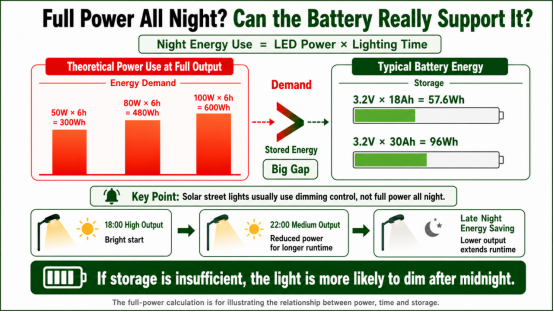
We can analyze power consumption with accurate data: Nighttime power consumption = LED power × Lighting hours
With full-power operation for 6 hours every night: • 50W LED × 6h = 300Wh • 80W LED × 6h = 480Wh • 100W LED × 6h = 600WhIn contrast, the common battery energy storage of regular all-in-one solar lights is limited: • 3.2V 18Ah battery = approx. 57.6Wh • 3.2V 30Ah battery = approx. 96Wh

The data shows clearly that conventional batteries cannot support full-power operation of 50W, 80W or 100W LED lights throughout the night. Reliable all-in-one solar street lights rely on intelligent controllers to realize staged dimming and energy-saving operation, instead of continuous full-power output.
Many high-nominal-power products only attract buyers with exaggerated parameters. Their supporting solar panels and batteries are not matched accordingly. The defects are hidden on sunny days with daily sufficient power replenishment, but fully exposed in rainy seasons with inadequate power generation.Therefore, wattage is never the only evaluation standard. The core indicator is whether the light can maintain basic and stable illumination during continuous rainy days.
Final Takeaway
The key to stable lighting during continuous rainy days is not high nominal power, but the balanced matching of power generation and power storage.
Under 5 hours of effective sunny sunshine, 20W, 25W and 35W solar panels achieve theoretical power generation of 100Wh, 125Wh and 175Wh respectively. In rainy seasons, the actual charging capacity drops to about 30%, only 30Wh, 37.5Wh and 52.5Wh.
Meanwhile, higher LED power means faster power consumption. A 50W LED operating for 6 hours consumes 300Wh, while a 3.2V 30Ah battery only stores 96Wh in theory. This fully explains why high nominal power does not equal reliable rainy-season performance. Reasonable dimming modes and complete system matching are indispensable.
When sourcing all-in-one solar street lights, do not be misled by promotional slogans such as “high brightness”, “high power” and “long battery life”. Always focus on whether the solar panel, battery, LED and controller system can maintain balanced and stable operation in rainy seasons.
Sunny-day performance is the basic threshold, while continuous rainy-day performance truly judges the rationality of product configuration.
#AllInOneSolarStreetLight #SolarLightPerformance #RainySeasonSolarLight #SolarSystemMatching #AfricanSolarProjects #OutdoorSolarLight