

Solar Lighting Upgrade Project of King Fahd Fountain Corniche, Jeddah, Saudi Arabia

Project Overview
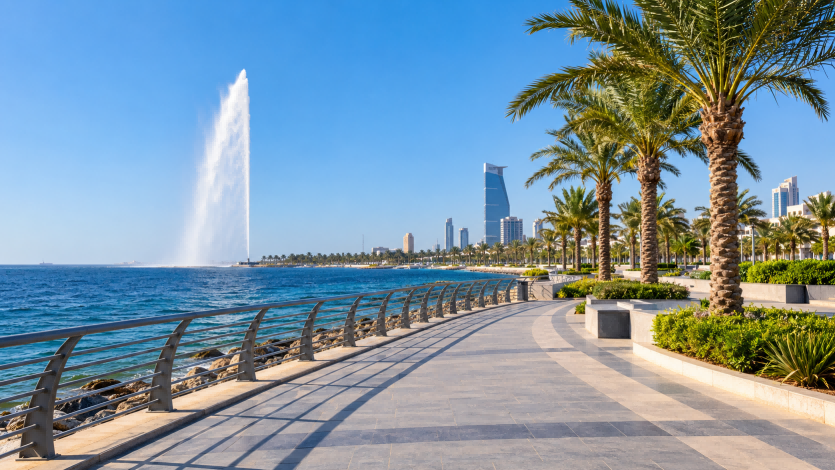
This project is located along the Jeddah Corniche in Jeddah, Saudi Arabia. King Fahd Fountain is one of the tallest fountains in the world and the most iconic waterfront landmark of Jeddah. The corniche features broad seaside walkways, leisure plazas, viewing platforms, landscaped green belts and public parking areas, serving as the core public space for evening strolling, family leisure and seaside sightseeing, with dense night-time foot traffic.
Before the upgrade, parts of the corniche walkways and plazas relied on traditional mains-powered street lighting with long cable routes and ageing wiring. Some viewing platforms and landscape nodes were under-lit, and sea-borne salt spray caused severe corrosion and frequent maintenance. Jeddah has extremely strong sunshine, providing excellent conditions for solar power. The upgrade covers walkways, viewing plazas, leisure platforms and landscape nodes along approximately 2,400 meters of the corniche, covering about 52,000㎡ of landscape area.
The scheme adopts solar garden lights and solar wall lamps. Solar garden lights are placed along seaside walkways, plaza edges and green nodes to provide continuous soft functional lighting. Solar wall lamps are mounted on seaside railing posts, landscape low walls and viewing platform side walls to outline the corniche path and strengthen night wayfinding and landscape layers. The system operates independently on solar energy without long-distance coastal cabling. Warm-white static lighting is used throughout, without coloured or dynamic effects, preserving the open, comfortable and safe night atmosphere of the waterfront public space.
Local Environmental Conditions
Jeddah has a hot desert climate with extreme summer highs frequently exceeding 45°C, intense sunshine and dry air. The coastal zone is exposed to Red Sea sea breezes carrying high salt and salt mist, which continuously corrodes metal housings and electrical connections. Night-time coastal winds are strong, and occasional dust storms occur. Outdoor fixtures must withstand high temperature, salt corrosion, dust and strong wind, while maintaining stable photovoltaic charging and thermal management under intense sun.
The Jeddah Corniche is heavily used in the evening by walkers, joggers and families, requiring a lighting system with reliable endurance for safe coastal walking and sightseeing.

Project Objectives
- Increase average illuminance of seaside walkways and viewing plazas from 6–10 lux before the upgrade to 18–24 lux, ensuring safe night-time coastal walking and sightseeing.
- Achieve illuminance uniformity of ≥0.65 in main pedestrian areas, eliminating dark zones at platform edges, landscape nodes and path corners.
- Deploy solar garden lights along walkways, plazas and green nodes; install solar wall lamps on railing posts, low walls and platform side walls for clear coastal night wayfinding.
- Apply unified warm-white static lighting without coloured or dynamic effects, preserving the open and comfortable waterfront night atmosphere.
- Keep the annual luminaire failure rate within ≤3%, adapting to Jeddah’s extreme heat, intense sun, salt corrosion and dust.
- Eliminate long-distance coastal cabling, reducing maintenance workload by approximately 58%–62% and cutting long-term electricity and coastal anti-corrosion cable costs.
- Support night-time strolling, jogging and family leisure, accommodating about 4,500 night-time users daily.

Project Outcomes
After completion, average illuminance of seaside walkways and viewing plazas reached 21 lux, within the 18–24 lux target range. Illuminance uniformity in main pedestrian areas was 0.67, meeting the ≥0.65 requirement. Dark zones at platform edges, landscape nodes and path corners were largely eliminated, making coastal walking paths clear and safe.
Solar garden lights were evenly arranged along walkways and plazas, forming a continuous pedestrian light belt. Solar wall lamps created soft contour lighting along railing posts and low walls, strengthening coastal night wayfinding. Powered by Jeddah’s abundant sunshine, the system remained stable under high heat, salt spray and dust, with good anti-corrosion sealing. The measured annual luminaire failure rate was 2.6%, below the 3% target. Maintenance workload decreased by approximately 60%, while long-distance coastal cabling and ongoing electricity costs were eliminated.
The night environment is open, soft and comfortable. Solar garden lights and solar wall lamps together form the night-time pedestrian lighting and wayfinding system for the corniche, ensuring safe coastal activities while enhancing the night quality of the public space around King Fahd Fountain.
