

Solar Lighting Upgrade Project of Mohammed VI Tower Compound, Rabat, Morocco


Project Overview
This project is located in Rabat, capital of Morocco. Mohammed VI Tower is a modern landmark of Rabat, integrating commercial office and public leisure functions. Surrounding the tower are landscaped plazas, circular pedestrian corridors, green courtyards, visitor parking zones and low landscape walls, serving residents and business visitors with stable day and night foot traffic.
Before the upgrade, outer walkways and green nodes of the compound used traditional mains lighting with long ageing cables. Some plaza corners and green paths suffered insufficient illumination. Rabat has abundant sunshine, which is ideal for solar lighting solutions. The renovation covers the external landscaped plaza, circular walkways, green courtyards and parking areas, with a total compound area of approximately 32,000㎡ and around 1,150 linear meters of pedestrian paths.
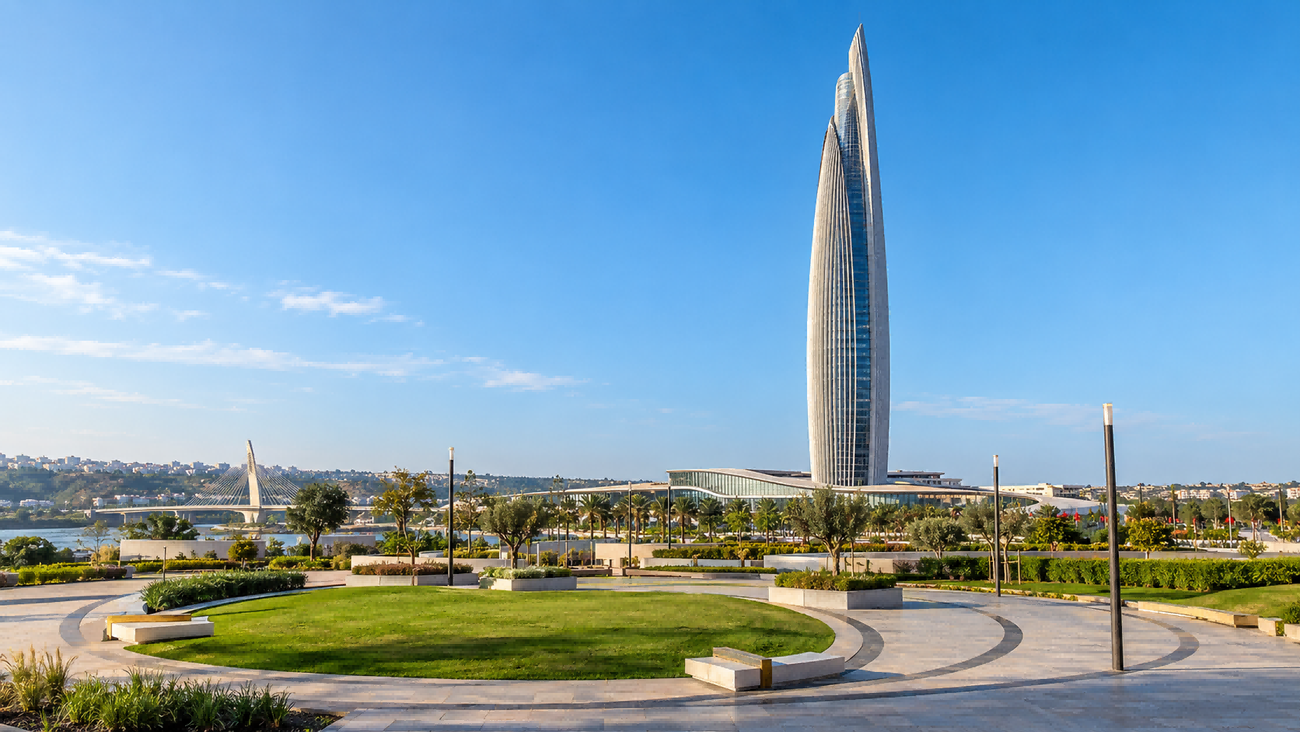
The scheme adopts solar garden lights and solar wall lamps. Solar garden lights are arranged in landscaped plazas, circular walkways and green courtyards to deliver continuous soft functional lighting. Solar wall lamps are mounted on low walls, corridor columns and platform side walls to create night guidance and enrich nightscape layers. The system runs independently on solar energy without extensive cable laying. Warm-white static lighting is adopted, no coloured dynamic lighting, matching the simple and grand night image of this modern landmark.
Local Environmental Conditions
Rabat features Mediterranean climate: hot and dry in summer, mild and rainy in winter. UV radiation is strong all year round. As a coastal city, the air contains light salt spray with obvious day-night temperature difference. Outdoor lamps must be waterproof, UV-resistant, lightly anti-corrosion and dustproof, ensuring stable energy storage in rainy seasons and adapting to alternating dry and wet climate.
The compound receives many business visitors and local residents at night. The lighting system requires stable endurance to guarantee pedestrian safety and good landscape experience.

Project Objectives
- Raise average illuminance of walkways and landscaped plazas from 7–12 lux before renovation to 19–25 lux to improve night-time safety for visitors.
- Reach illuminance uniformity ≥0.66 in main pedestrian zones, eliminating dark spots at path corners, plaza edges and green nodes.
- Deploy solar garden lights across plazas, circular walkways and green courtyards; install solar wall lamps on low walls, corridor columns and platform side walls for clear night wayfinding.
- Apply unified warm-white static lighting without coloured dynamic effects, maintaining the simple and grand night atmosphere of the modern landmark.
- Keep annual luminaire failure rate ≤3%, adapting to Rabat’s Mediterranean climate, strong UV and coastal light salt spray.
- Reduce cable construction and mains reliance, cutting maintenance workload by about 57%–61% and lowering long-term electricity and pipeline maintenance costs.
- Support night visits, citizen leisure and security patrols, accommodating about 2,100 night-time visitors daily.

Project Outcomes
After completion, the average illuminance of walkways and plazas reaches 22 lux, falling within the target range of 19–25 lux. Illuminance uniformity of main pedestrian areas hits 0.69, satisfying the requirement of ≥0.66. Dark areas at path corners, plaza edges and green nodes are largely removed, and night walking routes become clear.
Solar garden lights are evenly distributed along plazas, circular walkways and green courtyards to form continuous soft pedestrian light strips. Solar wall lamps cast gentle guiding light on low walls and corridor columns and improve the night recognition of Mohammed VI Tower compound. Powered by sufficient local sunshine, the system operates steadily under alternating dry-wet conditions, strong UV and mild coastal salt spray. Measured annual luminaire failure rate is 2.4%, below the 3% target. Maintenance workload drops by approximately 59%, removing heavy cable inspection and electricity expense.
The night scene is simple, grand and comfortable. Solar garden lights and solar wall lamps jointly build the pedestrian lighting and wayfinding system, ensuring traffic safety and strengthening the night visual identity of Rabat’s new landmark.
