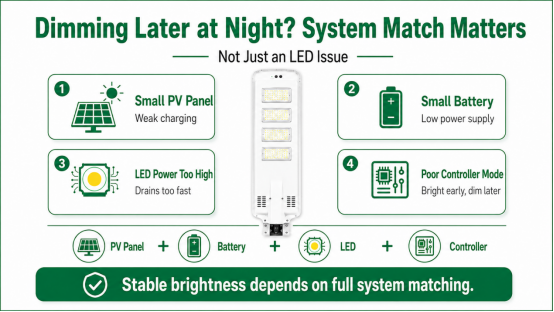
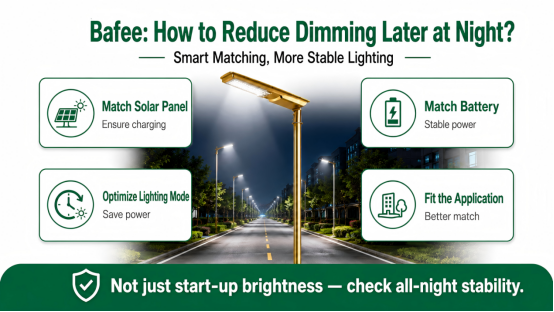
Most buyers judge all-in-one solar street lights by their initial brightness. However, instant brightness means little — real quality lies in stable performance throughout the entire night.A common issue in field projects: lights turn on super bright at dusk but dim drastically after midnight, or even power off early. This is not an LED failure, but a mismatched system between LED power, solar panels, batteries and controllers.Unlike grid-powered lights, solar street lights rely entirely on daytime solar charging and battery storage.
Luminous Flux Is Only Theoretical — Site Conditions Define Real Brightness
Standard 180 lm/W LEDs deliver fixed theoretical luminous flux:50W ≈ 9,000 lm | 80W ≈ 14,400 lm | 100W ≈ 18,000 lm | 120W ≈ 21,600 lm. These lab data cannot represent actual road performance. Real-world brightness is greatly affected by mounting height, road width, pole spacing, lens distribution, weather and dust coverage.The same 18,000 lm lamp will look dimmer at 6m height than 4m height, or on a 6m-wide road versus a 3m narrow lane. Paper specs never equal on-site effect.
Why Do Solar Lights Dim After Midnight?
Late-night dimming is mainly caused by insufficient energy storage and charging capacity:Power consumption reference (6-hour full-power lighting): 50W = 300Wh | 80W = 480Wh | 100W = 600Wh | 120W = 720Wh
The data shows regular batteries cannot support full-power lighting all night. Meanwhile, undersized solar panels fail to recharge enough energy during the day (affected by weather and installation angle).Without reasonable time-divided dimming control, lights consume massive power in the early night and inevitably dim after midnight.
Correct Sourcing Logic: Match Configurations to Scenarios
Blindly pursuing high wattage cannot guarantee stable lighting. Different scenarios require tailored system configurations:
3–4m height / 3m narrow road: Standard medium-low power configuration suffices
4–5m height / 4–6m road: Requires improved LED power and wide-angle lens
5–6m height / 6–8m wide road: Mandatory high-power LED, larger solar panel and bigger battery
All-night full brightness demand: Must upgrade both solar panel and battery capacity
Rural roads, factories, parking lots and farms have different lighting demands. A well-matched system ensures uniform illumination, no dark zones and all-night stability.
Conclusion
When purchasing all-in-one solar street lights, ignore exaggerated wattage and lumen marketing. A qualified solar light features matched LED power, solar panel, battery and intelligent dimming system.
The most reliable lights maintain steady brightness before and after midnight, work normally on cloudy/rainy days, and deliver consistent performance for long-term project
All-in-one solar street lights with mains backup or dual charging work perfectly for regions with long rainy, cloudy days.However, many buyers overlook one critical detail: local voltage and plug...
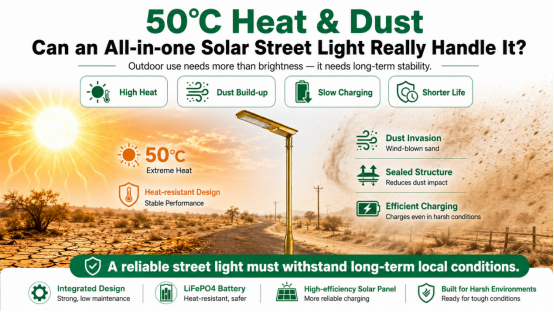
When sourcing all-in-one solar street lights, buyers usually prioritize power output, brightness and pricing. Yet for markets including Tanzania, Nigeria, Ethiopia, Ghana and the DRC, environmental adaptability is equally critical....