Rainy Season Solar Light Selection: Don’t Ignore Waterproof Grade, System Matching & Mains Backup Voltage

All-in-one solar street lights with mains backup or dual charging work perfectly for regions with long rainy, cloudy days.However, many buyers overlook one critical detail: local voltage and plug compatibility. Every country has unique grid voltage and plug standards. Without pre-verification, you will face incompatible adapters, charging failures, or extra costs for conversion plugs, ruining on-site performance.
For projects in Tanzania, Nigeria, Ethiopia, Ghana and the DRC, check these points before ordering dual-charging solar lights: • Local grid voltage standard • Local plug specification • Required charging mode • Region-tailored packaging & user manuals • Demand for solar + mains dual charging
For mains backup models, pick adapters with 100–240V wide voltage input to fit multiple markets flexibly. If single-voltage adapters are used, confirm compatibility with local power grids in advance.
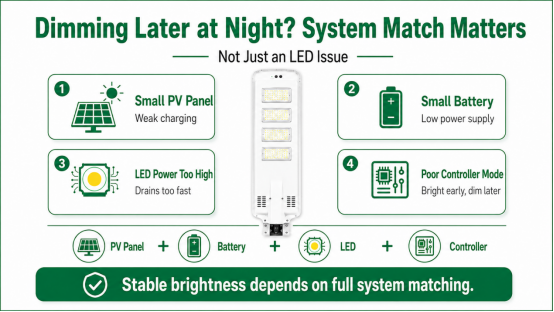
Also match adapter output parameters to internal systems like 3.2V battery packs and 6V solar panel systems. Different panel and battery combinations demand matching controllers and charging schemes. These small details heavily impact end-user experience. Full pre-order checks avoid after-sales troubles: failed charging, unstable power and extra adaptors.

Key Factors for Stable Performance in Rainy Seasons
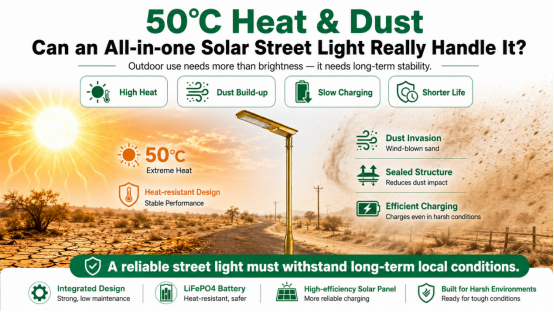
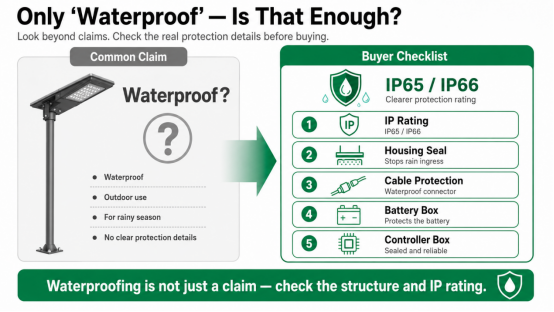
Generic "Waterproof" labels are not reliable. Six core metrics determine long-term durability: IP protection grade, full sealing design, solar panel wattage, battery capacity, controller program and mains voltage adaptability.
IP65 / IP66 waterproof & dustproof certification is essential Quality lights add protective seals on housing seams, lens edges, screw holes, wire outlets, battery and controller compartments to resist months of rain, humidity and UV exposure.
Solar panel & battery capacity decides nightly lighting hours Theoretical power output under 5 hours of clear sunshine:
25W panel = 125Wh
30W panel = 150Wh
35W panel = 175Wh Actual charging output drops drastically on rainy cloudy days.
Battery energy storage reference:
3.2V 18Ah = 57.6Wh
3.2V 30Ah = 96Wh Small battery storage leads to insufficient overnight illumination.
Mains backup units require wide voltage adapters & matched plugs Always confirm 100–240V input support and local plug standards for dual-charging fixtures.
Final Takeaway
When sourcing all-in-one solar street lights for rainy African areas, ignore superficial waterproof slogans and nominal wattage only. To guarantee steady operation year-round, prioritize complete sealed structure, certified IP65/IP66 protection, reasonable solar-battery matching and universal voltage adaptability. Trusted integrated solar lighting systems maintain consistent charging and stable lighting through persistent damp, heavy rain and overcast weather, effectively cutting common post-installation faults: water seepage, shortened runtime and mismatched charging accessories.

#AllInOneSolarStreetLight #SolarLightForAfrica #WaterproofSolarLight #MainsBackupSolarLight #RoadLightEngineering #SolarSystemMatching