Many Somali Buyers Expect Manufacturers to Deliver Complete Solar Street‑Light Solutions Based on Project BOQ, Road Width and Pole Height, Instead of Supplying Stand‑Alone Lamps Only


What many Somali engineering purchasers truly demand is not just individual solar street lights with a certain wattage rating, but full‑fledged solutions tailored to project BOQ (Bill of Quantities) and site‑specific conditions.
The same luminaire can yield entirely different performance requirements when deployed on different roads. Road width, pole height, pole‑to‑pole spacing and daily lighting duration all govern the required actual LED power, solar panel sizing, battery capacity and pole specifications.

1. Refer to the BOQ first, instead of starting from product catalogues
Sample requirements stated in a project BOQ:
‑ Road width: 6 m
‑ Pole height: 8 m
‑ Pole spacing: 25 m
‑ Quantity: 100 sets
‑ Daily lighting hours: 12 hours
Under such circumstances, manufacturers should avoid generic replies such as “we recommend 500 W solar street lights”.
A more valuable approach is to verify practical system configurations. For instance:
Actual LED power: 50 W | Solar panel: 100 W | Battery: 12.8 V 50 Ah
Theoretical energy storage of the battery:
12.8 V × 50 Ah = 640 Wh
Assume 50 W output for the first 5 hours, dimmed to 15 W for the subsequent 7 hours:
50 W × 5 h + 15 W × 7 h = 355 Wh
Only then can we evaluate whether the 640 Wh energy storage and 100 W solar panel provide sufficient safety margin for field operation.

2. Road width and pole height must be calculated jointly
Take another scenario: for a 4‑meter‑wide road with 6‑meter poles and 18‑meter pole spacing, requirements for lighting coverage, LED power and energy storage will decrease accordingly.
By contrast, if road width expands to 8 m, pole height rises to 10 m and pole spacing extends to 30 m, the identical set of specifications will no longer be suitable.
Therefore, engineering projects cannot rely solely on pole height. Three parameters must be assessed together:
Road Width + Pole Height + Pole Spacing
Combined, these three factors determine lighting coverage and real‑world load demand for luminaires.

3. A complete solution shall also cover installation and delivery scope
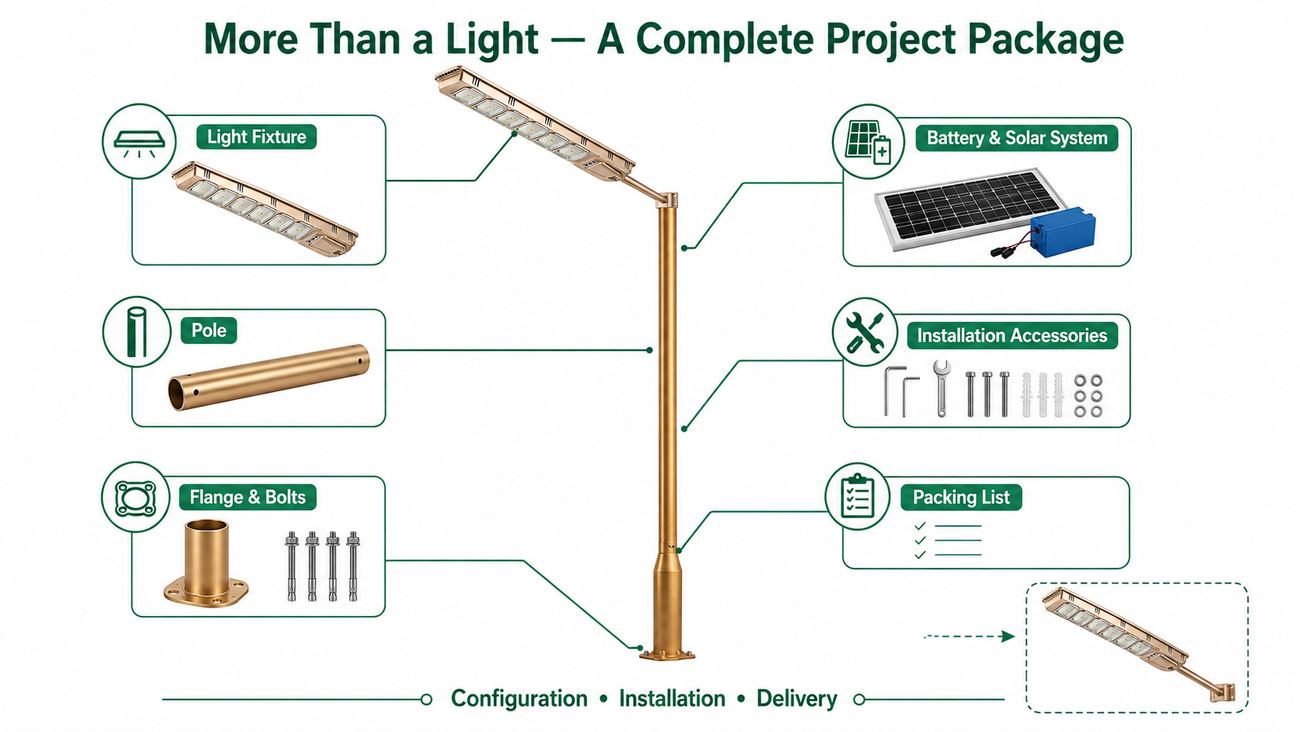
Engineering procurement rarely ends with lamp‑head supply alone. A full package should include:
‑ Luminaire model
‑ Pole height and structural specifications
‑ Solar panel wattage
‑ Battery parameters
‑ Control mode
‑ Flange plate and anchor bolts
‑ Installation accessories
‑ Packing list
‑ Installation recommendations
For a 100‑unit project where the BOQ specifies 8‑meter poles, the bill of materials for each set (luminaires, poles, flanges, bolts and accessories) shall be confirmed in advance. Missing components should not be addressed only after goods arrive on‑site.
For Somali engineering buyers, a valuable supplier does not merely quote unit prices for individual products. Instead, the supplier translates BOQ clauses, site road conditions and lighting requirements into a complete, procurable, installable and deliverable configuration solution.
All figures above serve as engineering selection examples. Final configurations shall be determined in accordance with project BOQ, road illuminance standards, local solar irradiance and on‑site installation conditions.