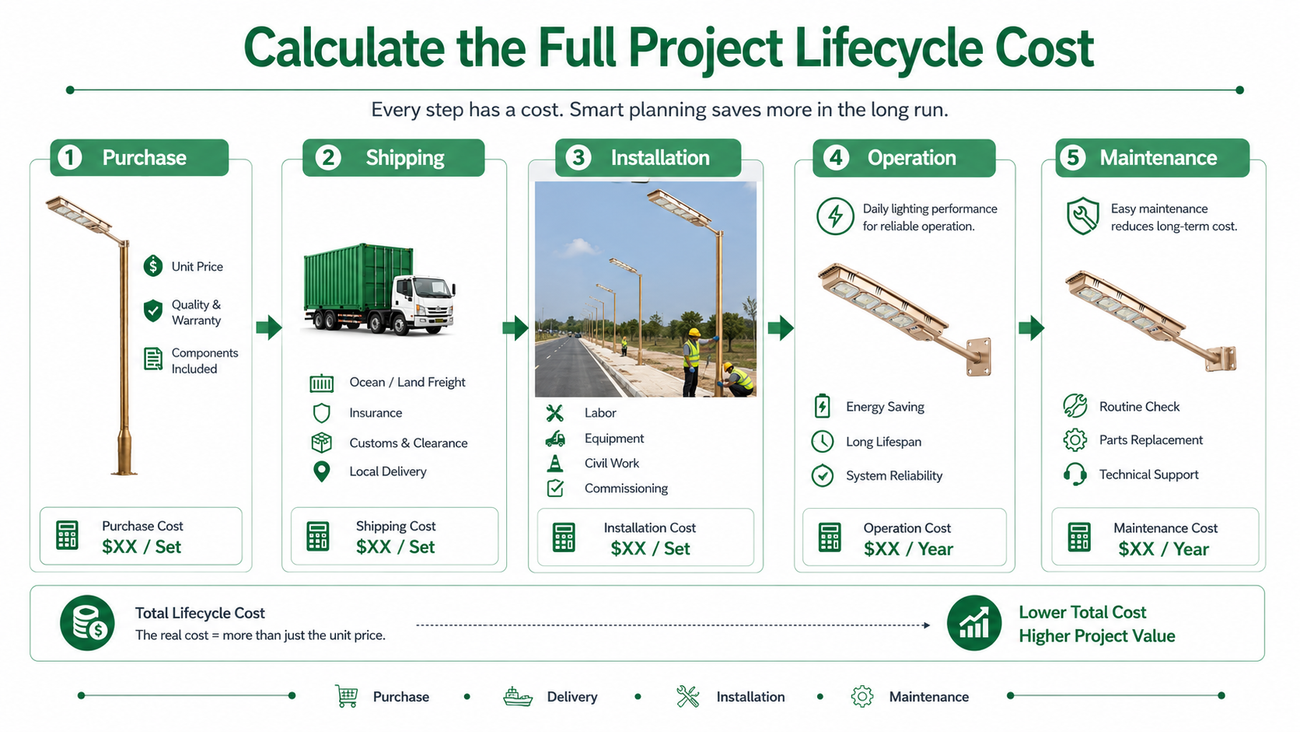
Nigerian Buyers’ Concern: Low Unit Purchase Price May Lead to Higher Overall Project Costs When Factoring in Poles, Freight, Installation and After Sales Maintenance


When procuring solar street lights for Nigerian projects, unit lamp prices are easy to compare. However, total project expenditure extends well beyond the luminaire itself.
For road lighting projects, it is critical to calculate full implementation costs in advance: Luminaires + Lamp Poles + Transportation + Installation + After sales Maintenance
1. Cheaper individual lamps do not guarantee lower overall installed costs
Assume a project requires 100 sets of solar street lights.
Luminaire Unit Price of Solution A is $20 lower per set than Solution B, generating an apparent saving during procurement: 100 × $20 = $2,000
Nevertheless, if Solution A does not come with properly matched poles, flanges or installation hardware, extra expenses will be incurred for each set: Pole and foundation accessories: $15 Supplementary spare part procurement: $5 Additional freight and on site handling: $8
Total incremental cost: 100 × $28 = $2,800
The subsequent extra expenses exceed the initial $2,000 saving.
Accordingly, engineering buyers should not only compare quotations for lamp heads, but evaluate the full cost of each complete set upon final installation.

2. Freight costs and packaging configurations directly impact project budgets
Solar street light consignments typically involve sea freight plus inland land transport from port to job site.
Separate shipments for poles, luminaires and accessories may trigger extra secondary transport and warehousing fees.
For a 100 set project, for instance, reshipping missing accessories could add $600 in freight charges, together with site delays and rescheduled installation work. These hidden costs are never reflected in the original luminaire quotation.
Best practice before order placement is to confirm: scope of supply per set, package quantity per consignment, matching pole availability, completeness of hardware kits, and feasibility of one time full shipment.

3. Real maintenance cost depends on the full scope of repair work
When a lamp malfunctions, repair expenses cover more than just replacement components.
For example, a replacement battery itself costs only $30. Additional charges may apply if the site sits far from spare parts storage: Round trip logistics: $20 Technician labour: $15 Dismantling, reassembly and tool usage: $10
Total real world repair cost per unit: 30 + 20 + 15 + 10 = $75
If 5 out of 100 lamps require servicing: 5 × $75 = $375
Therefore, Nigerian engineering purchasers should prioritize evaluating total project lifecycle cost and long term maintenance expenditure, rather than simply chasing the lowest upfront quotation.