

Many Ghanaian Buyers Cannot Tell Whether All‑in‑One or Split‑Type Solar Street Lights Suit Local Road Projects


When sourcing solar street lights for road projects in Ghana, many buyers ask directly: “Which one is better, all‑in‑one or split‑type?” In fact, neither design is inherently superior. The decision hinges on project scale, mounting height, nightly power consumption, and the required sizing of solar panels and battery storage.
1. All‑in‑one units are generally more convenient for rural and community roads
Sample project parameters:
‑ Pole height: 6 m
‑ Road width: approx. 4‑5 m
‑ Pole spacing: approx. 18‑20 m
‑ Actual LED operating power: approx. 30‑40 W
Assume 40 W output for the first 5 hours, dimmed down to 10 W for the subsequent 5 hours:
40 W × 5h + 10 W × 5h = 250 Wh
If the solar panel and battery can support this daily energy consumption, the all‑in‑one design shows prominent advantages. The lamp head, solar panel, battery and controller are fully integrated into one unit. No separate solar‑panel mounting or extra field wiring is required during installation.
For rural roads, community streets and large‑quantity roll‑out projects, this design simplifies both construction and after‑sales maintenance.
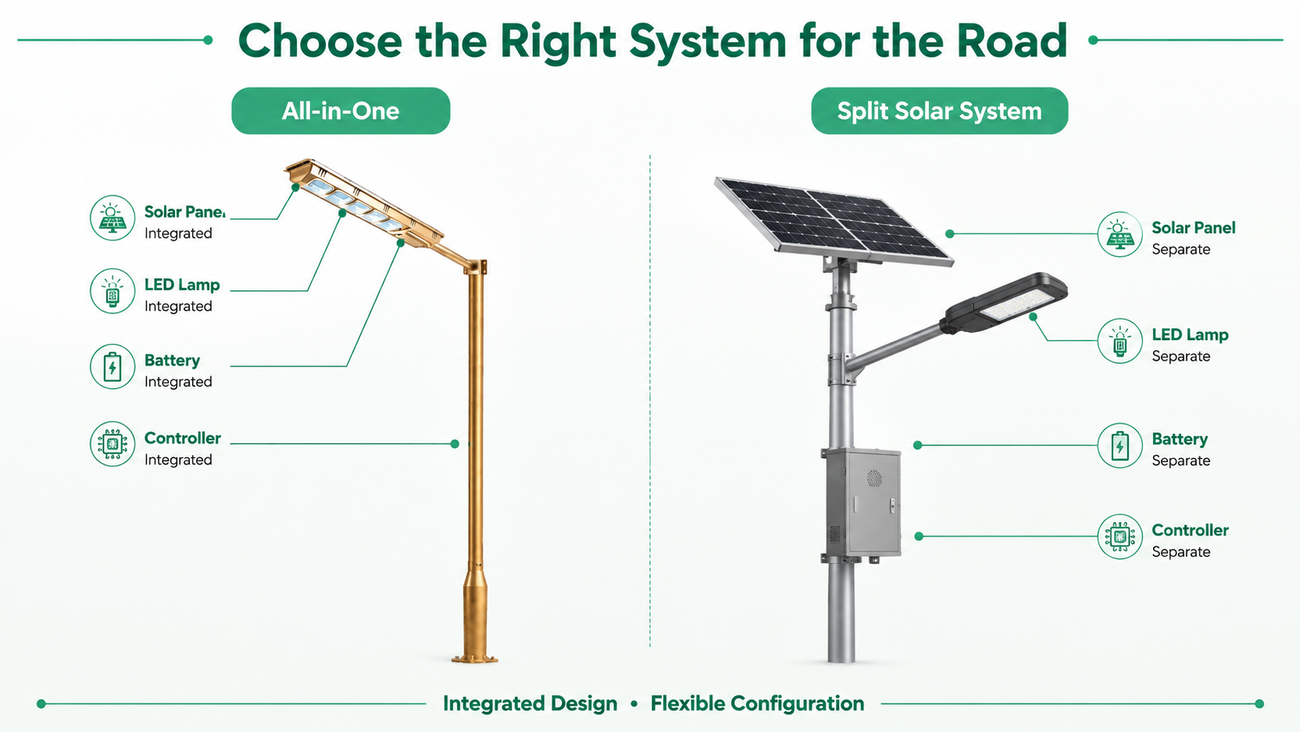
2. Split‑type offers greater configuration flexibility for wider roads and higher power requirements
Sample higher‑demand project parameters:
‑ Pole height: 8‑10 m
‑ Road width: 7‑10 m
‑ Pole spacing: approx. 25‑30 m
‑ Actual LED operating power: 60‑80 W
Assume 60 W output for 5 hours, then 15 W output for another 5 hours:
60 W × 5h + 15 W × 5h = 375 Wh
Larger solar panels and bigger energy‑storage margins are required under this load. For split‑type solar street lights, solar panels can be mounted independently. Panels of 100 W, 120 W or higher wattage can be deployed as calculated for the project. Tilt angle and orientation of panels can also be adjusted separately.
Accordingly, split‑type solutions provide broader configuration adjustability for high‑power roadways, tall poles, or projects with strict requirements for continuous lighting performance.

3. Compare project conditions instead of just product‑type names
Take a quantity of 50 lamps as an example:For a 5‑meter‑wide rural road with 6‑meter poles, fast installation and easy maintenance are
