

Why Do Loading Quantities Vary So Much for the Same 40HQ Container? Never Ignore Packaging Size When Sourcing All-in-One Solar Street LightsWhen purchasing all-in-one solar street lights, most buyers mainly compare unit price, power wattage, battery capacity and lighting duration.

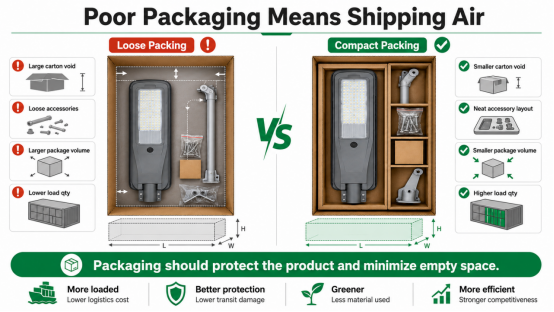
However, for bulk import projects, there is one critical factor that should never be overlooked: packaging size.
All-in-one solar street lights are not small-sized goods. The lamp body, solar panel, battery, mounting accessories and outer carton all take up container space. Unreasonable packaging design with large internal gaps will directly reduce the total loading quantity per container.
For the same 40HQ container, products with optimized packaging can hold far more sets, while poorly packaged items result in much fewer quantities. Although the total container freight remains the same, the shipping cost allocated to each set can differ greatly.
Therefore, during procurement, besides asking for unit prices, you must confirm these key details: • Exact packaging dimensions • Quantity per carton • Loading capacity for 20GP / 40GP / 40HQ containers • Shipping cost per set
These data directly determine your final landed cost.
1. Unreasonable Packaging Wastes Shipping Cost
Solar street lights are vulnerable to transportation damage, so packaging must be sturdy enough for long-distance shipping. However, over-packed designs with excessive cushioning waste valuable container volume.
Common packaging problems that cause cost waste: • Bulky cartons with large internal empty space • Disorganized placement of brackets, screws and manuals that increases overall volume • Non-optimized carton dimensions that fail to fit product structure • Overly thick packaging that sacrifices loading quantity
These hidden issues are hard to notice before shipment but greatly increase logistics expenses.
Before placing bulk orders, always verify full packaging specifications: • Single-set packaging size • Quantity per carton • Gross weight & net weight • Exact loading quantity for different container types • Volume per unit • Moisture-proof, compression-proof and anti-collision protection for long ocean transit
Qualified export packaging balances two core purposes: First, fully protect products and reduce transit damage. Second, minimize redundant gaps to maximize container space utilization.Well-optimized packaging stabilizes product quality and effectively controls overall sea freight.
2. Packaging Size Directly Decides Container Loading Quantity
For FCL (full container load) shipments, packaging volume is the decisive factor for loading capacity.
A 40HQ container has fixed usable space. Larger packaging size means fewer sets loaded. Even with identical total container freight, the unit shipping cost varies drastically.
Unit Shipping Cost Formula: Shipping cost per set = Total container freight ÷ Total loading quantity
Take a 40HQ container with a freight cost of $6000 as an example:
Scenario 1: Compact optimized packaging Total loading quantity: 2500 sets Unit shipping cost: 6000 ÷ 2500 = $2.4 per set
Scenario 2: Bulky unoptimized packaging Total loading quantity: 1000 sets Unit shipping cost: 6000 ÷ 1000 = $6 per set
With the same container and same total freight, poor packaging increases unit shipping cost from $2.4 to $6.This is why you cannot judge product competitiveness only by unit price or total freight. Always focus on actual loading quantity, allocated unit freight and space utilization rate. Bad packaging means you are paying to ship empty air.

3. Huge Cost Differences Between FCL and LCL Shipping
Order quantity determines your shipping method and overall cost.
Small orders usually adopt LCL (less than container load) shipping, which is flexible but comes with higher unit logistics costs, plus extra handling, warehousing and destination port charges from multiple transits.
Large-volume bulk orders suit FCL shipping perfectly. Full containers ensure safer transportation, more stable delivery conditions and lower average unit freight.
Small-batch trial orders may seem cheap in unit price, but high LCL shipping fees greatly raise final landed cost.
Reasonable order planning according to container loading standards effectively averages down logistics expenses.For new markets and new models, small trial orders are reasonable for market testing. But for long-term project supply and resale business, you must consider container loading efficiency and replenishment cycles to avoid repeated high-cost LCL shipments.

Final Takeaway
Packaging size is a core factor affecting the landed cost of all-in-one solar street lights.
Optimized and compact packaging protects products and maximizes container loading quantity, lowering unit shipping cost significantly. In contrast, oversized packaging leads to fewer loaded sets, making your final landed cost much higher even with a cheaper factory price.
With a standard 40HQ container at $6000 freight: • Optimized packaging: 2500 sets loaded / $2.4 unit freight • Unoptimized packaging: 1000 sets loaded / $6 unit freight
Smart procurement requires full verification of packaging details: ✅ Compact and reasonable packaging dimensions ✅ Accurate quantity per carton ✅ Exact loading capacity for 20GP / 40GP / 40HQ ✅ Real unit volume and allocated freight ✅ Suitable shipping method (FCL or LCL) ✅ Export-grade protective packaging design
Choosing a supplier with scientific packaging solutions and transparent loading data is far more reliable than simply chasing low unit prices. Reasonable packaging design creates real cost advantages for your overseas projects.#SolarStreetLight #AllInOneSolarLight #SolarProcurement #ShippingCost #ContainerLoading #ImportBusiness #AfricanSolarProjects