

Solar Lighting Upgrade Project of Abuja National Mosque Outer Compound, Nigeria

Project Overview
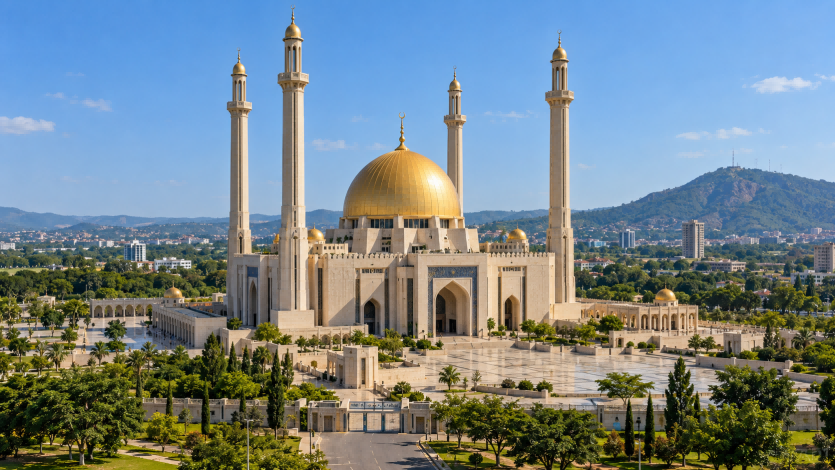
This lighting renovation project is located in Abuja, capital of Nigeria. Abuja National Mosque is a representative Islamic landmark in West Africa, famous for its grand golden dome and four towering minarets. The renovation covers the outer courtyard, landscape walkways, green park and visitor rest square of the mosque, excluding the interior prayer hall. Before renovation, old lighting cables were ageing with unstable power supply. Many green walkways lacked night lighting, bringing risks for visitors and security patrol. Mains power caused continuous electricity cost, cables easily degraded under tropical heat and maintenance cost was high.
The upgrade includes outer courtyard, circular visitor walkways, green nodes and rest square. Total renovated compound area is approximately 35,000㎡, total length of outer walkways is about 1,400m.
Solar garden lights and solar wall lamps are adopted in this scheme. Solar garden lights are arranged on courtyard walkways and green nodes to deliver basic pedestrian lighting. Solar wall lamps are mounted on outer walls and corridor facades to create quiet and solemn atmosphere. The lighting system uses independent photovoltaic energy storage without long-distance cable laying. Warm-white static lighting is used without colourful dynamic effects to respect the solemn temperament of religious architecture.
Local Environmental Conditions
Abuja features tropical wet-and-dry climate with high temperature all year round, heavy rainfall in wet season and sufficient sunshine in dry season. Outdoor lamps must resist high temperature and heavy rain, adapting to hot humid environment. The mosque compound receives worshippers and tourists all year round, and visitor volume surges on Friday Jumu’ah and religious festivals. The lighting system requires long-term stable operation to guarantee safe passage and peaceful atmosphere.

Project Objectives
- Raise average illuminance of circular outer walkways from 7–12 lux before renovation to 19–25 lux, ensure safety for visitors and security patrol at night.
- Reach illuminance uniformity ≥0.65 on courtyard walkways to remove dark spots.
- Deploy solar garden lights along walkways and green nodes, install solar wall lamps on compound walls and corridors for tranquil night scene.
- Apply unified warm-white static lighting, no colourful dynamic lights to preserve solemn religious atmosphere.
- Control annual luminaire failure rate within ≤3%, adapt to tropical high temperature and heavy rain humid environment.
- Cancel long-distance cable laying, reduce maintenance workload by 57%~61%, eliminate ongoing electricity expense and save energy.
- Support night visiting and security patrol, accommodating about 2,600 visitors daily.

Project Outcomes
After handover, average illuminance of outer walkways reaches 22 lux within target range, uniformity 0.69 meeting ≥0.65 requirement. Solar garden lights are evenly placed on courtyard walkways and green nodes to provide continuous soft light. Solar wall lamps installed on compound walls cast gentle warm light and maintain the quiet solemn atmosphere of mosque outer zone.
The solar lighting system stores energy with strong local sunshine without long cables. Lamps withstand high temperature and heavy rain, running stably under Nigerian tropical climate. Measured annual failure rate is 2.4% below control target. A large amount of cable construction work is saved. Maintenance workload of inspection and replacement drops by 59% compared to old mains lighting, with zero long-term electricity cost and good environmental performance.
The compound night scene is soft and tranquil. Warm light of solar fixtures does not overshadow the solemn religious building while guaranteeing pedestrian safety. This project becomes a benchmark solar landscape lighting project for religious compound in West Africa.
