

Unsuitable Solar Lights After Shipment? Don’t Let Shipping Cost Turn Into Rework Cost

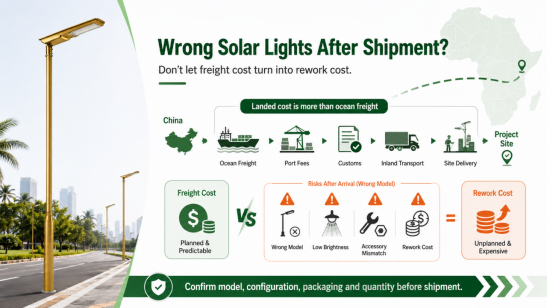
Importing all-in-one solar street lights already involves considerable ocean freight expenses. Many buyers only calculate the shipping cost from China to the port, ignoring the huge hidden risks behind bulk shipments.
Once the goods arrive at the destination and prove unsuitable — improper models, insufficient brightness, mismatched accessories, damaged packaging, or unfit for on-site installation — the loss is no longer limited to product defects. Instead, your overall shipping cost, time cost, and project delivery schedule will all be severely affected.
This issue is extremely critical for African markets including Tanzania, Nigeria, Ethiopia, Ghana, and the DRC. Procurement cannot only focus on basic ocean freight. You must also take into account destination port fees, customs clearance charges, inland transportation, and final on-site delivery costs.
Any supplementary shipment, product replacement, or on-site rework after arrival will generate extremely high additional expenses. When shipping costs are already high, random product selection is never cost-effective. The real way to save money is to confirm the correct model, configuration, packaging, and quantity in one go.
1. Different African Markets Cannot Follow the Same Shipping Cost Logic
Shipping conditions, port charges, clearance policies, and inland logistics vary greatly across different African countries.
Some destinations are close to seaports with convenient local delivery. Some projects are located in inland cities, where secondary transportation costs are much higher. Many rural, mining, farm, and remote construction sites require extra budget for final-mile distribution.
Moreover, customs regulations and local miscellaneous fees differ by country. Without advance confirmation, your overall budget will easily exceed expectations after goods arrival.Therefore, you should never calculate costs merely based on China-to-port freight. The true landed cost covers the entire logistics chain to the final destination.
For project-based orders, calculating only port arrival cost will lead to serious budget shortages in later-stage construction.
Before procurement, always clarify your delivery standard:
• Port arrival
• Warehouse arrival
• Distributor store arrival
• Exact project site delivery
• Whether inland transit or remote distribution is required
The clearer your destination positioning, the more accurate your overall cost assessment will be.
#AllInOneSolarLight #SolarStreetLight #AfricanSolarProjects #SolarProcurement #ShippingCost #ImportLogistics #ProjectSourcing