

Solar Lighting Upgrade Project of Royal Opera House Muscat Compound, Oman

Project Overview
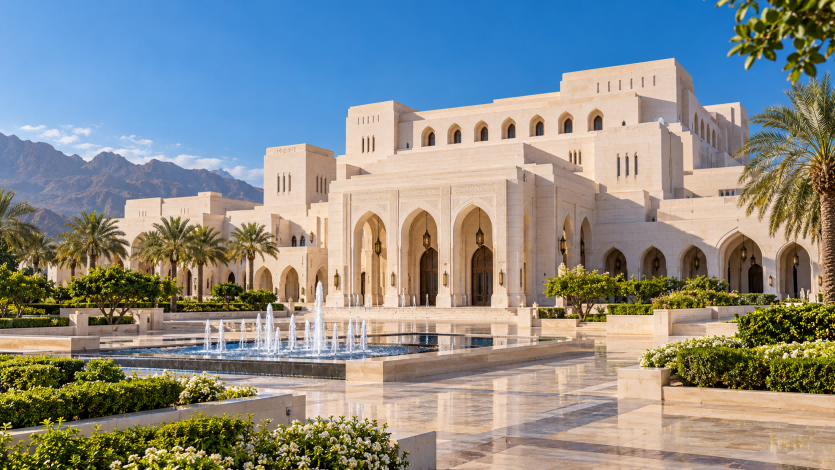
This project is located in Muscat, the capital of Oman. The Royal Opera House Muscat is a leading cultural landmark in the Gulf region, combining modern opera functions with Islamic architectural language. With an elegant exterior, it is surrounded by landscaped plazas, covered walkways, fountain courtyards, garden paths and visitor service areas, hosting operas, concerts, artistic events and high-level receptions.
Before the upgrade, the original mains lighting system had long cable routes, while some garden paths and outer corridors were under-lit, making night wayfinding unclear. Traditional fixtures were energy-intensive, and cable maintenance plus electricity costs were significant. Muscat has abundant sunshine, making it suitable for solar-powered solutions that reduce long-term electricity expenses. The upgrade covers the external landscaped plaza, garden paths, fountain courtyard, outer corridors and visitor service areas, with a total renovated area of approximately 31,000㎡ and about 1,180 linear meters of surrounding pedestrian paths.
The scheme adopts solar garden lights and solar wall lamps. Solar garden lights are placed along plaza edges, garden paths and fountain nodes to provide soft base lighting. Solar wall lamps are installed on outer corridors, arcade columns, entrance porticos and compound walls to highlight architectural layers and strengthen night guidance. The system operates independently on solar energy, reducing mains dependency and cable laying. Warm-white static lighting is used throughout, without coloured or dynamic effects, preserving the elegant, restrained and refined night atmosphere of the opera house.
Local Environmental Conditions
Muscat has a hot desert climate with high temperatures year-round, intense summer heat, strong sunshine, dry air and occasional sand and dust. Outdoor fixtures must withstand high temperature, UV exposure and dust while maintaining stable photovoltaic charging and thermal management. Solar garden lights and solar wall lamps require robust sealing and electrical protection under prolonged exposure to heat, dryness and sand.
The Royal Opera House often hosts evening performances, with concentrated visitor dismissals. Compound lighting must ensure continuous illumination at the entrance plaza, corridors and walkways, balancing refined cultural atmosphere with pedestrian safety.
Local Environmental Conditions
Muscat has a hot desert climate with high temperatures year-round, intense summer heat, strong sunshine, dry air and occasional sand and dust. Outdoor fixtures must withstand high temperature, UV exposure and dust while maintaining stable photovoltaic charging and thermal management. Solar garden lights and solar wall lamps require robust sealing and electrical protection under prolonged exposure to heat, dryness and sand.
The Royal Opera House often hosts evening performances, with concentrated visitor dismissals. Compound lighting must ensure continuous illumination at the entrance plaza, corridors and walkways, balancing refined cultural atmosphere with pedestrian safety.

Project Objectives
- Increase the average illuminance of walkways, landscaped plaza and fountain courtyard from 7–12 lux before the upgrade to 21–27 lux, improving safety for visitors and evening dismissals.
- Achieve illuminance uniformity of ≥0.68 in main pedestrian areas, eliminating dark zones at entrance corridors, garden paths and fountain nodes.
- Deploy solar garden lights across the landscaped plaza, garden paths and fountain courtyard; install solar wall lamps on outer corridors, arcade columns and compound walls for refined wayfinding.
- Apply unified warm-white static lighting without coloured or dynamic effects, preserving the elegant and restrained image of the Royal Opera House.
- Keep the annual luminaire failure rate within ≤3%, adapting to Muscat’s hot, sunny, dry and dusty environment.
- Reduce mains dependency and cable maintenance costs, lowering maintenance workload by approximately 57%–61% and enabling green-energy operation.
- Support evening performance dismissals, visitor departure and security patrols, accommodating about 2,000 night-time users daily.

Project Outcomes
After completion, the average illuminance of walkways, landscaped plaza and fountain courtyard reached 24 lux, within the 21–27 lux target range. Illuminance uniformity in main pedestrian areas was 0.70, meeting the ≥0.68 requirement. Dark zones at entrance corridors, garden paths and fountain nodes were significantly reduced, improving night wayfinding for visitors.
Solar garden lights were evenly arranged along the landscaped plaza, garden paths and fountain courtyard, forming a soft and continuous night-time pedestrian environment. Solar wall lamps created refined guiding light along outer corridors, arcade columns and compound walls, enhancing the architectural hierarchy of the opera house at night. Powered by abundant local sunshine, the system remained stable under high temperature, dryness and dust. The measured annual luminaire failure rate was 2.5%, below the 3% target. Maintenance workload decreased by approximately 59% compared with the old system.
The night environment is elegant, calm and refined. Solar garden lights and solar wall lamps together create a restrained night atmosphere suitable for a cultural landmark, ensuring visitor safety while strengthening the Royal Opera House’s quality image as a cultural icon of Muscat.
