

Nigerian Buyers Concerns: Lamp Water Ingress, Controller Failure & Shortened Battery Lifespan Caused by High‑Temperature, Heavy Rain and Long‑Term Outdoor Exposure


Once solar street lights are deployed outdoors in Nigeria, buyers seldom worry whether the lights work right after installation. Their real concern lies in long‑term reliability: can the luminaires keep operating stably after years of scorching heat, heavy rainfall and constant sun‑rain exposure?
1. Prioritize waterproof construction for heavy‑rain scenarios
Solar street lights are commonly marked IP65 or IP66.
Simple explanation:
‑ IP65: Protected against low‑pressure water jets
‑ IP66: Resistant to high‑pressure powerful water jets
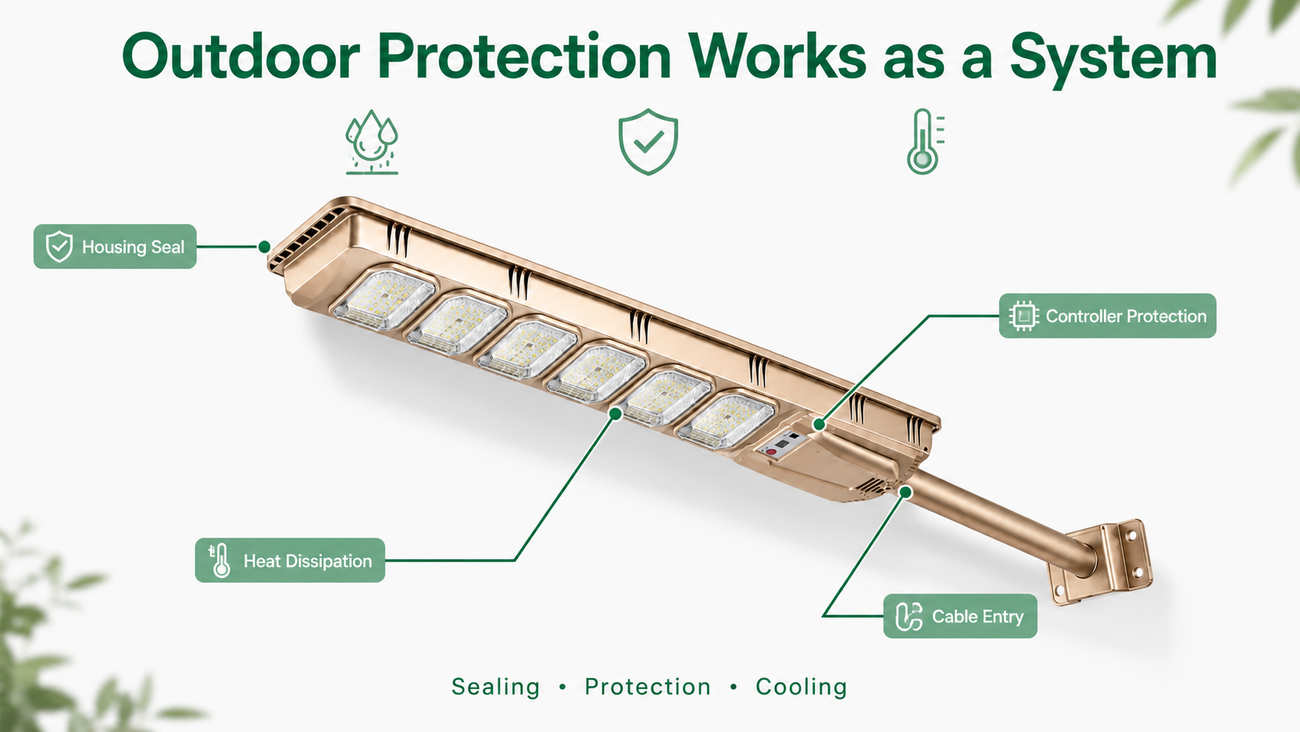
However, buyers should not rely solely on the IP rating. It is equally critical to check proper sealing for housing joints, controller compartments, physical button areas and cable entry points.
For instance, a luminaire may be exposed to heavy rainfall once per day throughout a 90‑day rainy season. Its housing and sealing structures must withstand repeated massive water splashes. Attractive appearance alone cannot guarantee stable long‑term waterproof performance.

2. High temperature impairs both controllers and batteries
Some outdoor project sites across Nigeria receive intense direct sunlight. Internal temperature inside enclosed lamp housings frequently rises above ambient air temperature.
Given an ambient temperature of 40℃, electronic components sealed inside the lamp can reach even higher operating temperatures. Hence buyers need to verify:
‑ Whether the controller is equipped with over‑temperature protection;
‑ Whether the battery is rated for high‑temperature outdoor operation;
‑ Whether the lamp body adopts well‑designed heat‑dissipation structures.
Batteries suffer accelerated capacity degradation under persistent high‑temperature conditions. If the system carries only minimal capacity margin, late‑night runtime will degrade noticeably after a period of operation.
3. Long‑term reliability depends on combined performance of sealing, heat dissipation and protective functions
Take a luminaire with theoretical battery energy storage as an example:
3.2V × 30Ah = 96Wh
If nightly real‑world power consumption reaches around 70Wh, roughly 73 % of total stored energy is consumed every night.
When compounded with heat‑induced battery capacity loss or frequent low‑power protection triggers from the controller, long‑term system stability will face severe stress.
Experienced purchasers therefore do not merely ask “what is the IP rating”. They cross‑validate multiple factors: IP protection grade, housing sealing workmanship, controller protection logic, battery thermal tolerance and heat‑dissipation design.
For long‑term outdoor projects in Nigeria, the complete system architecture must jointly withstand high heat, heavy rain and years of service. Over‑inflated individual specifications do not equal reliable field performance.
