

Many Nigerian Distributors Focus on 40HQ Container Loading Quantity for Solar Street Lights, as Container Capacity Directly Impacts Import Costs


Many Nigerian Distributors Focus on 40HQ Container Loading Quantity for Solar Street Lights, as Container Capacity Directly Impacts Import Costs
When Nigerian distributors source solar street‑lights, besides unit product prices, the total number of sets per full container heavily influences final import expenses.
Sea freight for a 40HQ container is generally charged on a full‑container basis. If each set has a large packaging volume, fewer units fit inside the container even with favourable product pricing. This pushes up the apportioned sea‑freight cost per unit significantly.
Therefore, when sending inquiries, distributors should avoid merely asking:
“How much is this model?”
They should also confirm these key figures:
Carton Size, Packing Qty, CBM, 40HQ Loading Qty
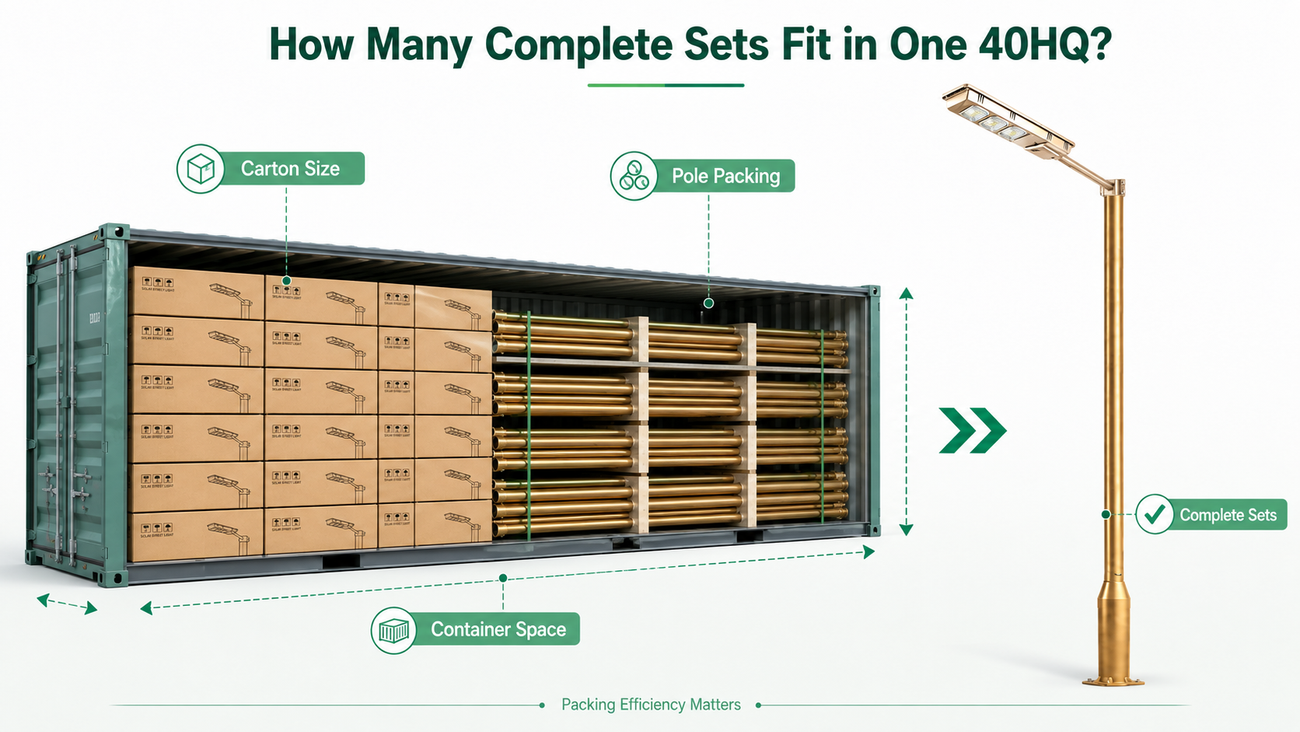
1. Container loading quantity is determined by per‑set packaging volume
Take an all‑in‑one solar street light with carton dimensions:
60 × 35 × 15 cm
Volume per carton:
0.60 × 0.35 × 0.15 = 0.0315 m³
Estimated usable volume of a 40HQ container is approximately 68 m³ for theoretical calculation:
68 ÷ 0.0315 ≈ 2158 cartons
In real‑world loading, 100 % volume utilisation cannot be achieved. Factors including carton geometry, stacking orientation, gaps between packages and loading method must be considered.
Assume practical space utilisation rate of 85 %:
2158 × 85 % ≈ 1834 sets
This illustrates the notable gap between theoretical volume calculation and actual achievable loading quantity for one single 40HQ container.

2. Lamp poles reshape overall container‑loading logic
For complete packages consisting of luminaires plus lamp poles, calculations cannot rely only on lamp‑head carton dimensions.
Example scenario:
While 1800 lamp‑heads can fit into one container, length and bundling constraints for 8‑meter poles limit pole capacity to only 500 sets per container.
Consequently, the real quantity of complete saleable kits within this container is merely:
500 sets
Distributors need to confirm the Complete Set Loading Qty, instead of only enquiring how many lamp‑head cartons can be shipped.

3. Loading quantity directly drives per‑unit logistics cost
Sample total sea‑freight and associated charges from China to destination port for one 40HQ container: $6,000
Case 1: 500 complete sets loaded
Average freight cost:
$6,000 ÷ 500 = $12 per set
Case 2: Optimised packaging enables loading of 650 complete sets
Average freight cost:
$6,000 ÷ 650 ≈ $9.23 per set
Cost difference per set ≈ $2.77
Total cost difference for 650 sets ≈ $1,800
