

Illuminating Jakarta’s Icon: Lighting Retrofit at Monumen Nasional (Monas) Square


Project Overview
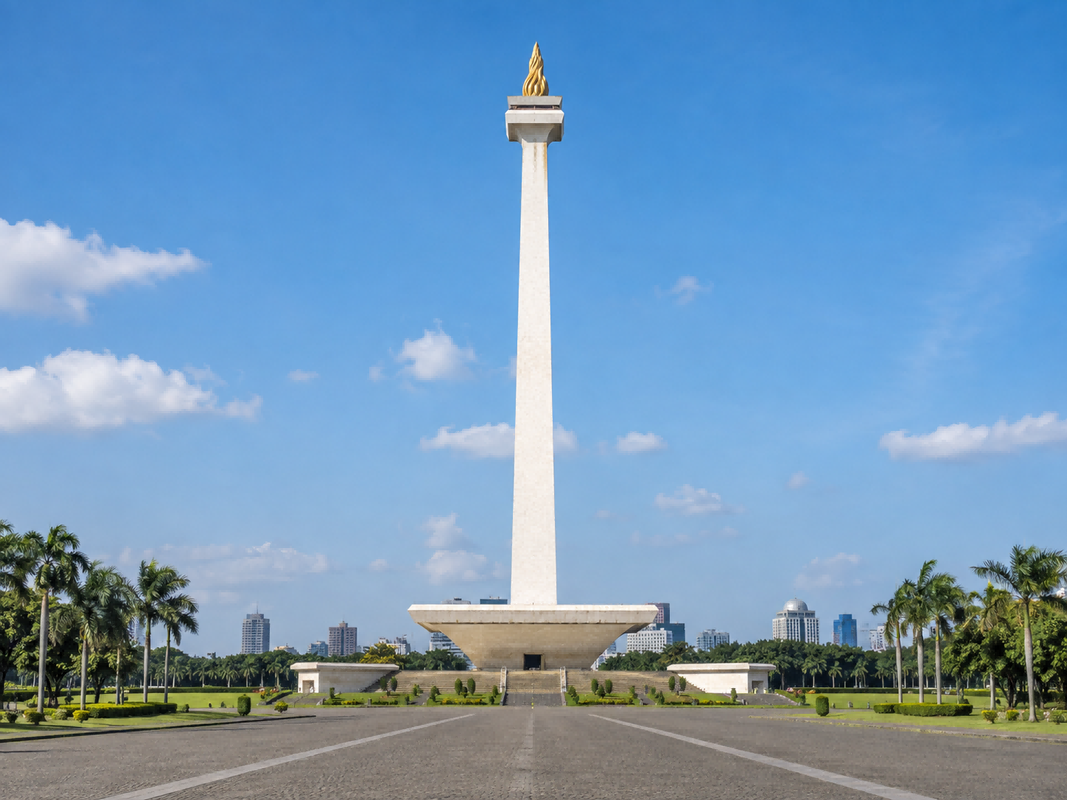
Standing in the heart of Central Jakarta, Monumen Nasional (Monas) is Indonesia’s national symbol and a defining urban landmark. The monument takes the form of a white obelisk crowned by a gilded flame sculpture, surrounded by a vast central plaza and a circular promenade. This project delivers a comprehensive lighting retrofit across the Monas central plaza and the surrounding ring walkway, covering approximately 68,000 square meters of paved plaza area and a 1.4-kilometer circular pedestrian path. Prior to the upgrade, the plaza and walkway relied on aging high-pressure sodium and conventional flood luminaires that suffered from severe lumen depreciation and uneven light distribution, leaving the site dim at night and falling short of the public-safety and visual-quality expectations of a national landmark.
For lighting configuration, linear wall-washers evenly illuminate the monument base and its relief-carved walls, highlighting the historical reliefs and architectural texture at the tower’s foot; narrow-beam floodlights project upward from the plaza ground onto the mid-upper tower body and the gilded flame sculpture at the top, emphasizing the obelisk’s vertical elegance and the golden quality of the flame; bollard and in-ground lights supplement functional lighting along the circular promenade. The entire system uses a unified warm-white palette with no colored or dynamic lighting. The upgraded system now operates steadily, delivering markedly improved nighttime brightness and visual comfort.
Local Environmental Conditions
Jakarta lies near the equator and has a tropical rainforest climate, characterized by year-round high temperature and high humidity, with annual average temperatures of 27–30°C and relative humidity consistently above 75%. The monsoon season, from November to March, brings intense, concentrated rainfall that subjects the plaza and walkways to prolonged water exposure. As a coastal city, Jakarta also carries elevated chloride levels in the air, exposing metal housings, reflectors, and electrical connections to persistent salt-spray corrosion; wall-washers and floodlights must therefore feature high-grade waterproofing, dust protection and salt-spray corrosion resistance. In addition, the plaza sees an average of about 18,000 visitors per day, with higher peaks on weekends and holidays, placing demanding requirements on the reliability, safety, and continuous-operation capability of the lighting system.

Project Objectives
- Significantly raise nighttime illuminance across the plaza and circular promenade from the pre-retrofit 8–13 lux to the target range of 22–28 lux, improving pedestrian safety and comfort for residents and visitors.
- Improve nighttime uniformity to ≥ 0.70 in main activity zones and eliminate hot spots and dark zones, ensuring a consistent visual experience across all plaza areas.
- Use linear wall-washers to evenly illuminate the base relief walls, combined with narrow-beam floodlights projecting upward onto the mid-upper tower and gilded flame, reinventing the landmark’s nighttime image with a unified warm-white palette, free of colored or dynamic lighting.
- Keep the annual luminaire failure rate within ≤ 3%, with wall-washers and floodlights specifically adapted to the harsh outdoor conditions of high temperature, high humidity, heavy rainfall and salt-spray corrosion.
- Reduce manual inspection and maintenance frequency, cutting maintenance workload by 60%–63% compared with the pre-retrofit baseline.
- Ensure safe nighttime passage and viewing experience for approximately 18,000 daily visitors.
Project Outcomes
Following completion, the average illuminance across the Monas central plaza and circular walkway rose from 8–13 lux before the retrofit to 22–28 lux after, landing within the design target range. Illuminance uniformity in the main activity zones reached and remained above 0.70, largely eliminating nighttime hot spots and dark patches. Once in operation, the system kept the annual luminaire failure rate within 3%, with the wall-washers and floodlights operating stably under high-temperature, high-humidity and salt-spray conditions, with no seal failure or widespread lumen depreciation. On-site inspection and replacement workload for the maintenance team dropped by approximately 61%, within the expected 60%–63% range.
The plaza now offers evenly lit, dignified nighttime illumination. Wall-washers evenly light the base relief walls, while narrow-beam floodlights project upward from the ground onto the tower body and the gilded flame at its apex; the white tower and golden flame form a harmonious, restrained nighttime relationship. Evening strolling, resting, and sightseeing have clearly improved, and the landmark’s nighttime image has been elevated as a whole, earning recognition from both the plaza management and the visiting public.

