

Government House of Thailand, Bangkok — Warm-White Exterior & Perimeter Lighting Retrofit


Project Overview
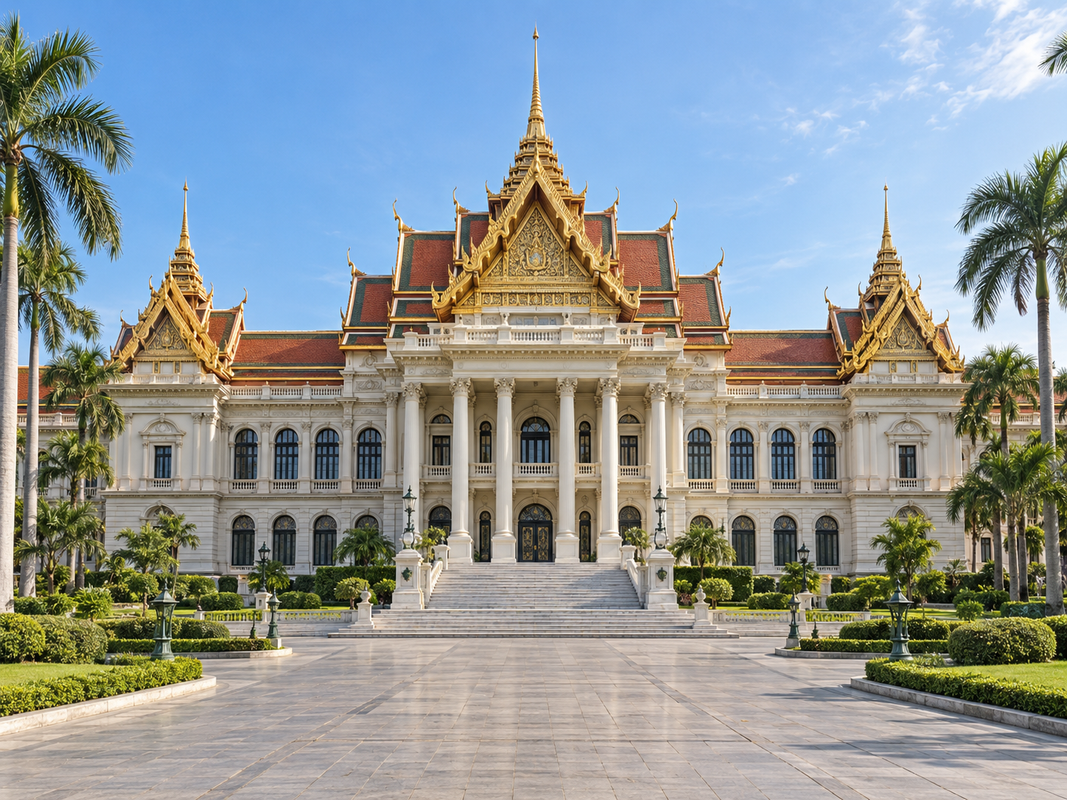
Located in central Bangkok, the Government House campus is one of Thailand’s most important administrative complexes. The site combines traditional Thai multi-tiered rooflines with a neoclassical columned main building, serving daily government operations, official receptions and major public functions. Before the retrofit, the campus relied on aging high-intensity gas-discharge luminaires that suffered from severe lumen depreciation, uneven distribution and frequent maintenance, undermining both nighttime pedestrian safety and the dignified public image of the site.
The project covers approximately 28,000 m² of public open space, together with 1,850 linear meters of pedestrian walkways connecting the main building, side wings and perimeter roads. The design follows a “safe, restrained, low-maintenance” principle, using a single warm-white static palette. For lighting configuration, linear wall-washers provide continuous, even outlining of the main building’s eaves and roofline, while floodlights deliver focused projection on entrance steps, colonnade facades and landscape nodes; bollard and in-ground lights supplement functional lighting along walkways. No colored, dynamic or animated lighting is used; the facade retains its original material character, preserving the sober, civic character of the compound.
Local Environmental Conditions
Bangkok has a tropical monsoon climate with distinct wet and dry seasons. The wet season runs from May to October, with concentrated rainfall, frequent short-duration storms and thunderstorms, and persistently high temperature and humidity—nighttime relative humidity often stays above 80%. From November to April, the dry season is relatively clear, with little airborne dust and good visibility.
Under these conditions, outdoor luminaires must withstand long-term high humidity, salt-laden air and repeated heavy rainfall, making the sealing rating, anti-corrosion coating and thermal structure of wall-washers and floodlights key engineering requirements. At the same time, on-duty staff, security patrols and occasional visitors continue to move through the campus at night, so lighting must remain reliable and stable over long operating hours.

Project Objectives
- Raise the average nighttime illuminance of public areas and walkways from 11 lux to around 25 lux, meeting safety requirements for an administrative compound.
- Achieve an illuminance uniformity of ≥ 0.70 across public areas and walkways, eliminating the old “bright spots, dark patches” pattern.
- Use linear wall-washers to continuously outline the main building’s eaves and roofline, combined with floodlights to project the entrance colonnade and steps, maintaining a dignified, restrained nighttime appearance with a unified warm-white palette, free of colored, dynamic or flashing light.
- Keep annual luminaire failure rate at ≤ 3%, with wall-washers and floodlights specifically suited to Bangkok’s prolonged heat, humidity and concentrated rainy season.
- Reduce routine outdoor lighting maintenance workload by 60%–63% through long-life, high-reliability fixtures.
- Support safe nighttime movement for approximately 3,200 daily pedestrian visits by duty staff, security and visitors.

