

Don’t Trust Nominal Battery Capacity! True Solar Light Endurance Depends on Actual Matching Performance

The battery is the core component that determines solar street light endurance during consecutive rainy days. On sunny days, the solar panel can replenish power daily, causing little load pressure on the battery. However, when sunlight is insufficient for consecutive days during rainy seasons, the battery has to bear all the power supply pressure.
Many solar light products are advertised with “large-capacity batteries”, but have limited actual power storage capacity. They work well in the short term on sunny days, but the nighttime lighting duration will be significantly shortened once the rainy season arrives.
When evaluating battery configuration, never judge merely by the nominal capacity marked on parameter sheets. Comprehensive judgment must be combined with actual application scenarios: • Daily required lighting duration • Full-night constant lighting demand • Availability of automatic intelligent dimming mode • Sustainable lighting days for consecutive rainy weather • Matching degree between LED power and battery capacity • Battery adaptability for long-term outdoor high-temperature environments
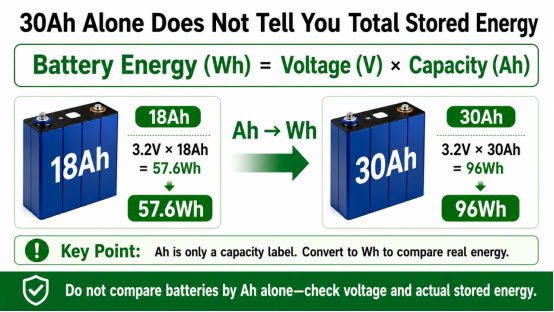
Battery energy storage can be calculated with a professional and simple formula: Battery Energy (Wh) = Voltage (V) × Capacity (Ah)
Calculation examples: 3.2V 18Ah = 57.6Wh 3.2V 30Ah = 96Wh
Take a solar light equipped with a 3.2V 30Ah battery (96Wh theoretical energy storage) as an example: If the LED works continuously at 20W full power, the theoretical endurance is 96Wh ÷ 20W = 4.8 hours If the LED works continuously at 10W power, the theoretical endurance is 96Wh ÷ 10W = 9.6 hoursWith an intelligent controller that sets high brightness in the early night and low power dimming in the late night, the overall battery lighting duration will be greatly extended.
This fully proves that battery capacity cannot be evaluated independently of LED lighting power. Lights nominally marked 50W, 80W or 100W will cause extremely high battery load if running at full power throughout the night.
Especially under the outdoor high-temperature environment of about 50℃ common in African regions, batteries with insufficient configuration margin will suffer obvious attenuation of lighting endurance after long-term high-temperature operation.
Therefore, for outdoor project markets including Tanzania, Nigeria, Ethiopia, Ghana, and DRC, battery configuration selection should never rely on superficial nominal data, but focus on whether it can adapt to local real usage conditions and meet actual lighting demands.To sum up, sourcing solar street lights for rainy-season markets cannot follow ordinary sunny-day evaluation standards. Sufficient theoretical power generation on sunny days does not guarantee stable operation in consecutive rainyweather.

A 30W solar panel generates 150Wh per day under 5 hours of effective sunny sunlight, while the actual power generation drops to 45Wh-60Wh per day (30%-40% efficiency) on rainy days. In addition, battery performance cannot be judged by nominal Ah value alone; it must be converted into actual Wh energy storage.
A 3.2V 18Ah battery stores 57.6Wh of electricity, and a 3.2V 30Ah battery stores 96Wh of electricity. Excessive nighttime power consumption will make it impossible for the battery to support long-hour stable lighting.
Accordingly, solar light procurement must focus on confirming local rainy-season sunlight conditions, solar panel power, actual battery energy storage, nighttime power consumption, and intelligent control modes.
High-quality solar street lights suitable for rainy-season markets are not only bright on sunny days, but also maintain stable basic lighting during consecutive rainy days, effectively reducing after-sales risks caused by insufficient endurance.
#SolarBattery #SolarLightEndurance #HighTemperatureSolarLight #SolarProcurementTips #AfricaRoadLighting #AllInOneSolarLight