

Dim Light in Late Night on Rainy Days? Solar Panel Size Defines Rainy-Season Performance of All-in-One Solar Street Lights

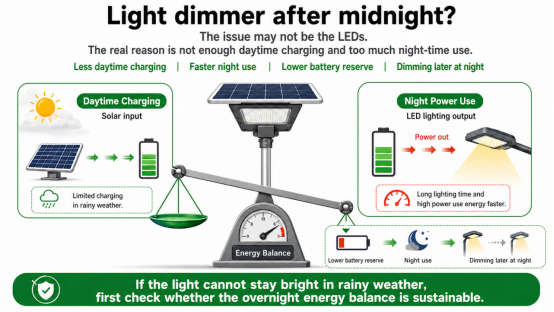
Many all-in-one solar street lights work perfectly right after installation on sunny days. However, various problems start to appear once the rainy season comes or under consecutive overcast and rainy weather.
Common field issues: • Slow daytime charging speed • The battery cannot be fully charged • Obvious dimming in the late night • Insufficient lighting hours after consecutive rainy days • Huge gap between advertised battery life and actual performance
In most cases, the lights do not fail completely. The core problem is the mismatching of solar panel, battery, LED power, and control system. When selecting all-in-one solar street lights, you cannot only check the brightness of the lamp head. Both solar panels and controllers are equally critical. The solar panel determines how much power can be stored during the day, while the control system defines how power is consumed at night. Insufficient daytime power generation plus excessive nighttime power consumption inevitably leads to poor endurance on rainy days.
1. Undersized solar panels lead to insufficient charging in rainy seasons
The lamp head brightness is never the only evaluation standard. The solar panel configuration directly determines the upper limit of power generation.
A small solar panel may barely meet the demand on sunny days. But in cloudy and rainy weather, charging efficiency drops sharply, the battery cannot get enough power supplement, and nighttime lighting duration is greatly affected.
Under consecutive rainy days, sunlight irradiation is already limited. If the solar panel power is insufficient, the following problems will be unavoidable: • Slow charging speed • Unfinished battery charging • Late-night dimming • Shortened lighting hours after rainy days
Take mainstream configurations for reference, calculated based on 5 hours of effective sunlight on sunny days: • 20W solar panel: approx. 100Wh/day theoretical generation • 25W solar panel: approx. 125Wh/day theoretical generation • 35W solar panel: approx. 175Wh/day theoretical generation
In rainy seasons, the actual charging efficiency drops to roughly 30% of sunny-day performance: • 20W solar panel: approx. 30Wh/day • 25W solar panel: approx. 37.5Wh/day • 35W solar panel: approx. 52.5Wh/dayThe performance gap becomes extremely obvious during rainy seasons. Smaller solar panels struggle severely with power replenishment on rainy days, while well-matched solar panels deliver far more stable rainy-season endurance.
Therefore, procurement cannot focus merely on LED power. Always verify the matching degree between solar panel and battery. Products with high nominal lamp power but undersized solar panels are high-risk choices for rainy-season markets.
#AllInOneSolarLight #SolarPanel #RainySeasonLighting #SolarStreetLight #SolarPowerGeneration #AfricanSolarProjects