

Why Cheaper Unit Price Doesn’t Mean Lower Cost? Understand CBM Shipping Cost for All-in-One Solar Street Lights

Most buyers focus only on the unit price when sourcing all-in-one solar street lights.
Common questions are always the same: “How much is this model?” “What’s the wattage?” “How big is the battery?” “Do you have a cheaper option?” “What is the sea freight for the whole order?”
However, in international procurement, the final landed cost of all-in-one solar street lights is far more than the factory unit price. It also includes sea freight, packaging volume, container loading quantity, destination port fees, customs clearance costs and local inland transportation fees.
Very often, a product with a low quoted price ends up costing much more after shipping. This is extremely common for integrated solar street lights, which come with complete lamp bodies, solar panels, batteries, mounting accessories and full carton packaging.
If the packaging structure is not optimized with large gaps inside the carton, each set occupies much more shipping space, resulting in significantly higher ocean freight.
Therefore, the core of solar light procurement is not simply chasing the lowest unit price, but calculating the real landed cost after all shipping and local fees.
1. Sea Freight Calculation: Volume Matters More Than Weight
All-in-one solar street lights belong to volume-based cargo — bulky in size but not extremely heavy.
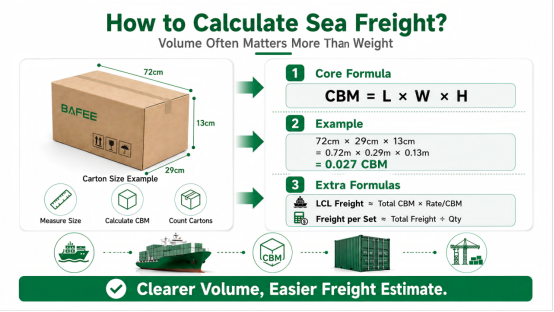
For LCL (less than container load) shipments, shipping lines charge by either volume or weight, whichever is higher. For solar street lights, freight is almost always calculated byCBM (cubic meter).
CBM Calculation Formula: Single carton CBM = Length (m) × Width (m) × Height (m)
Example: Carton size: 72cm × 29cm × 13cm Convert to meters: 0.72m × 0.29m × 0.13m Single set volume = 0.027 CBM
LCL Freight Logic: Total Freight = Total CBM × Freight rate per CBM Unit shared freight = Total freight ÷ Total quantity
For FCL full container shipments (20GP / 40GP / 40HQ), the total container cost is fixed. In this case, packaging volume directly determines how many sets can be loaded in one container, which finally decides the unit shipping cost per light.
In short: sea freight cost is not determined by total shipment fee only, but by how much volume each single set occupies.
#SolarStreetLight #AllInOneSolarLight #SolarProcurement #ShippingCost #CBM #AfricanSolarProjects #ImportCost