

Why 120W Solar Street Lights Deliver Different Brightness? Don’t Only Look at Labeled Wattage

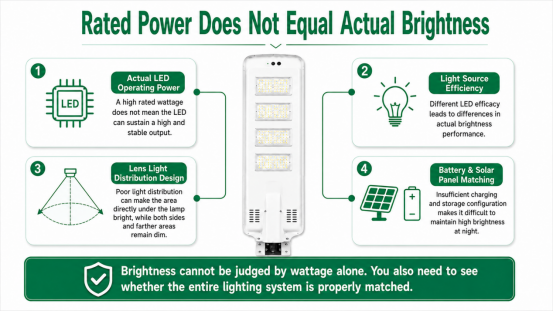
Many buyers judge solar street lights simply by wattage labels like 100W or 120W, assuming higher wattage means brighter lighting and equal wattage means equal performance. However, nominal wattage never equals real-world lighting effect in actual road and rural projects.

All-in-one solar street lights work in real outdoor environments. What truly matters is practical performance: road brightness, illumination coverage, all-night stability, and no obvious dimming after midnight.
Two lights both marked 120W can have100% brightness difference, mainly due to different LED luminous efficacy, luminous flux, optical design, and system matching between solar panels and batteries.
Simple luminous flux formula: Theoretical Luminous Flux = Wattage × LED
Luminous Efficacy
– 120W @ 90 lm/W = 10,800 lumens – 120W @ 180 lm/W = 21,600 lumensSame wattage label, double the light output gap. When selecting solar street lights, focus on LED efficacy, reasonable luminous flux, professional light distribution, and reliable battery & solar panel matching, not just printed wattage.

Nominal Wattage ≠ Actual Brightness
Many exaggerated wattage labels are based on housing size or lamp bead quantity, not stable real working power. Even with standard 180 lm/W high-efficiency LEDs, theoretical brightness varies greatly by power:
– 50W ≈ 9,000 lumens – 80W ≈ 14,400 lumens – 100W ≈ 18,000 lumens – 120W ≈ 21,600 lumensHigh luminous flux does not guarantee good road lighting. Poor lens design creates concentrated light under the pole with dark edges. Unmatched batteries and solar panels also cause severe late-night dimming.
Avoid Wattage Inflation — Check Full Configuration
The biggest procurement pitfall is chasing high labeled wattage without checking core specs. A reliable all-in-one solar street light requires matched configurations:
Actual LED working power, solar panel wattage, real battery capacity, controller solution, dimming modes, installation height, road width adaptability, and effective lighting range.Many 120W-labeled lights only adopt 60W real LED power with undersized panels and batteries.

Power consumption comparison: – 60W for 6h = 360Wh – 120W for 6h = 720Wh
Genuine 120W lighting requires double the energy supply. Unmatched systems inevitably lead to dim late-night performance, poor rainy/cloudy day endurance, and insufficient lighting hours.
Conclusion
Never judge solar street lights by nominal wattage alone. True lighting quality depends on real LED power, high luminous efficacy, sufficient luminous flux, and fully matched system configurations.Reliable solar street lights feature transparent specs, truthful power output, and stable all-night performance — not exaggerated marketing numbers.
