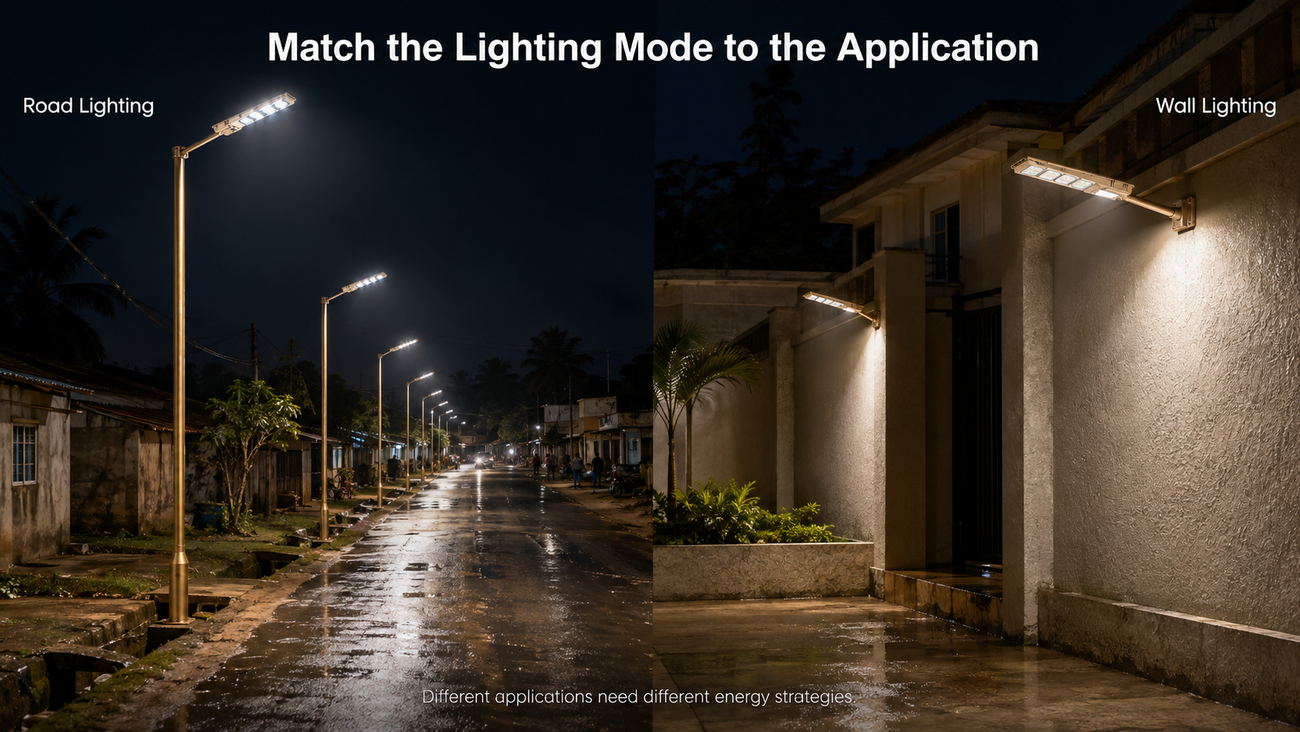
Nigerian buyers commonly worry that solar street lights fail to operate at full brightness throughout the night during prolonged rainy season overcast weather.


When executing solar street light projects in Nigeria, runtime performance through the rainy season is a top concern for purchasers. All in one solar street lights tend to perform well under sunny test conditions. However, after two or three consecutive cloudy days, the real test becomes whether the daily solar energy harvested can offset the power consumed at night.
1. Calculate daily energy gain versus energy consumption during consecutive cloudy days
Take a luminaire fitted with a 30 W solar panel as an example. Estimate 5 hours of effective sunshine on sunny days: 30 W × 5 h = 150 Wh per day.
Assume charging efficiency drops to 30 % of sunny day output on cloudy / rainy days: 150 Wh × 30 % = 45 Wh harvested per cloudy day.
Suppose actual nightly energy consumption of the lamp is 70 Wh. This creates a daily energy deficit: 70 Wh − 45 Wh = 25 Wh deficit per day.
With three consecutive days of similar cloudy weather, the theoretical cumulative deficit can reach: 25 Wh × 3 = 75 Wh.
This explains why many units work fine on the first night, yet shift into energy saving mode in the late hours after several rainy, overcast days.

2. Reserve sufficient battery capacity margin for the rainy season
Example: a 3.2 V, 30 Ah battery delivers theoretical stored energy: 3.2 V × 30 Ah = 96 Wh.
If nightly consumption is 70 Wh, roughly 73 % of total battery capacity is consumed overnight. This causes no obvious issue when sufficient solar recharge happens each sunny day. But during rainy seasons, daily harvested energy may only fall between 40 Wh 50 Wh, and remaining battery capacity will keep dropping day by day.
For Nigerian rainy season projects, it is insufficient to only check battery Ah rating. Buyers must also verify solar panel wattage, real world nightly power draw, and the required number of backup cloudy days the system needs to support.

3. Control strategy defines how limited energy lasts through the whole night
Running at full maximum output for the entire night is often impractical in rainy conditions.
Sample time dimming scenario: 15 W power output for the first 4 hours: 15 W × 4 h = 60 Wh. Reduced to 5 W for the subsequent 6 hours: 5 W × 6 h = 30 Wh. Total nightly consumption ≈ 90 Wh.
By contrast, running constantly at 15 W for a full 10 hour night requires: 15 W × 10 h = 150 Wh.
With identical hardware, well programmed time phased dimming control can greatly ease nighttime energy consumption pressure.
Therefore, when confirming configurations for Nigeria’s rainy climate, purchasers should focus on these practical questions:
- How many consecutive cloudy rainy days are expected?
- How many actual lighting hours are required per night?
- Is lower power / energy saving mode acceptable for late night hours?
- Are the solar panel, battery pack and controller logic properly matched as a complete system?
Stable rainy season performance does not rely on one single oversized specification. It depends on achieving a reasonable balance between daily solar energy input and nightly energy output.