

Must Solar Wall Lights Use Heavy Die Cast Aluminium Housings? Thermal Performance Depends on Heat Dissipation Design Rather Than Metal Weight


Many buyers automatically associate heavy, metal
rich housings with superior heat dissipation and better quality. From a product
engineering perspective, thermal management is not improved simply by adding more metal mass. You first evaluate real heat output of the fixture, then define suitable heat
dissipation architecture.
For solar wall
lights such as 831XL, design focus lies on heat generated by LED modules and drivers under normal operation, plus effective paths for heat evacuation.
Thermal
system design should not start with the assumption “full die
cast aluminium housing is mandatory”. Instead, calculate required cooling capacity based on real power rating, LED operating temperature, overall fixture temperature rise and long
run performance requirements.

831XL adopts lightweight UV resistant ABS outer housing, paired with aluminium core PCB substrates exactly where thermal conduction is required. Heat generated by LEDs transfers first to the aluminium PCB and dissipates further via structural design. With well controlled LED junction temperature, PCB temperature and overall fixture temperature rise, this architecture delivers sufficient cooling for long term operation.
Buyers should note that heavy die cast aluminium comes with tangible downsides.
First: product weight. Heavier fixtures increase workload for packaging, handling, warehousing and field installation. For distributors and contractors ordering hundreds or thousands of units, extra unit weight accumulates into higher logistics and construction costs.
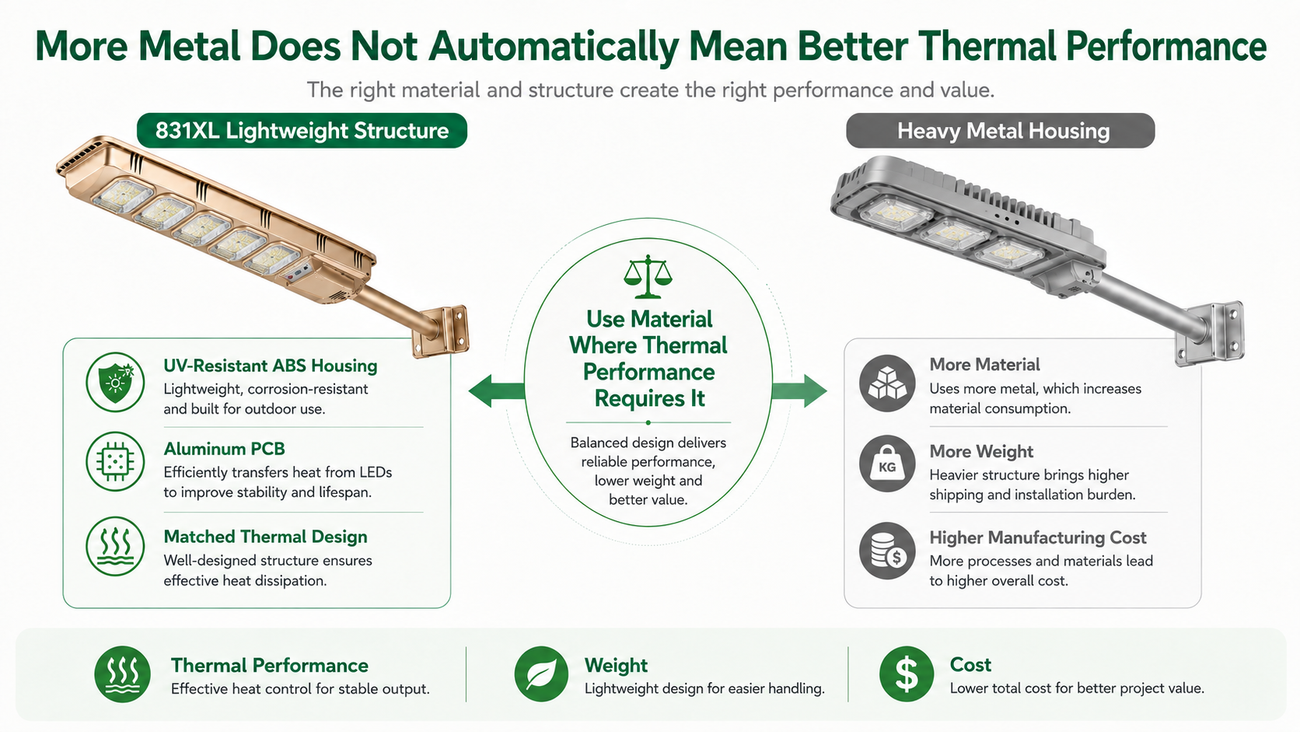
Second: material and manufacturing expense. Die cast aluminium requires dedicated moulds, casting, machining, surface finishing and additional assembly steps. Where thermal load does not demand large amounts of metal, those extra manufacturing costs are passed on to buyers.
Sophisticated thermal design prioritises placing conductive materials exactly where heat transfer is needed, rather than maximising aluminium volume.
831XL’s design assigns primary thermal conduction work to aluminium PCBs, while the outer shell uses lightweight UV resistant ABS. It meets outdoor durability and cooling requirements without redundant weight and material consumption.
From the buyer’s standpoint, comparison metrics should not be “how many kilograms of aluminium are used”. Evaluate operating temperature stability, long term reliability, installation convenience and total procurement plus logistics cost.
Excellent engineering does not mean stacking excessive materials. It achieves required reliability through well optimised mechanical structures.
