

Most Nigerian Solar Street‑Light Purchasers Fail to Judge Adequate Mounting Height, Fearing Failure to Meet Road Lighting Requirements After Delivery


Many first‑time Nigerian buyers of all‑in‑one solar street lights focus on power rating, price and brightness. Yet after installation, they find mismatches between pole height and site road conditions. Impressive product specifications do not guarantee satisfactory real‑world lighting results.
1. Identical luminaire delivers different performance at 4 m and 6 m mounting heights
Higher mounting height generally expands light coverage area, while light intensity per unit ground area becomes more diffused.
Simple example:
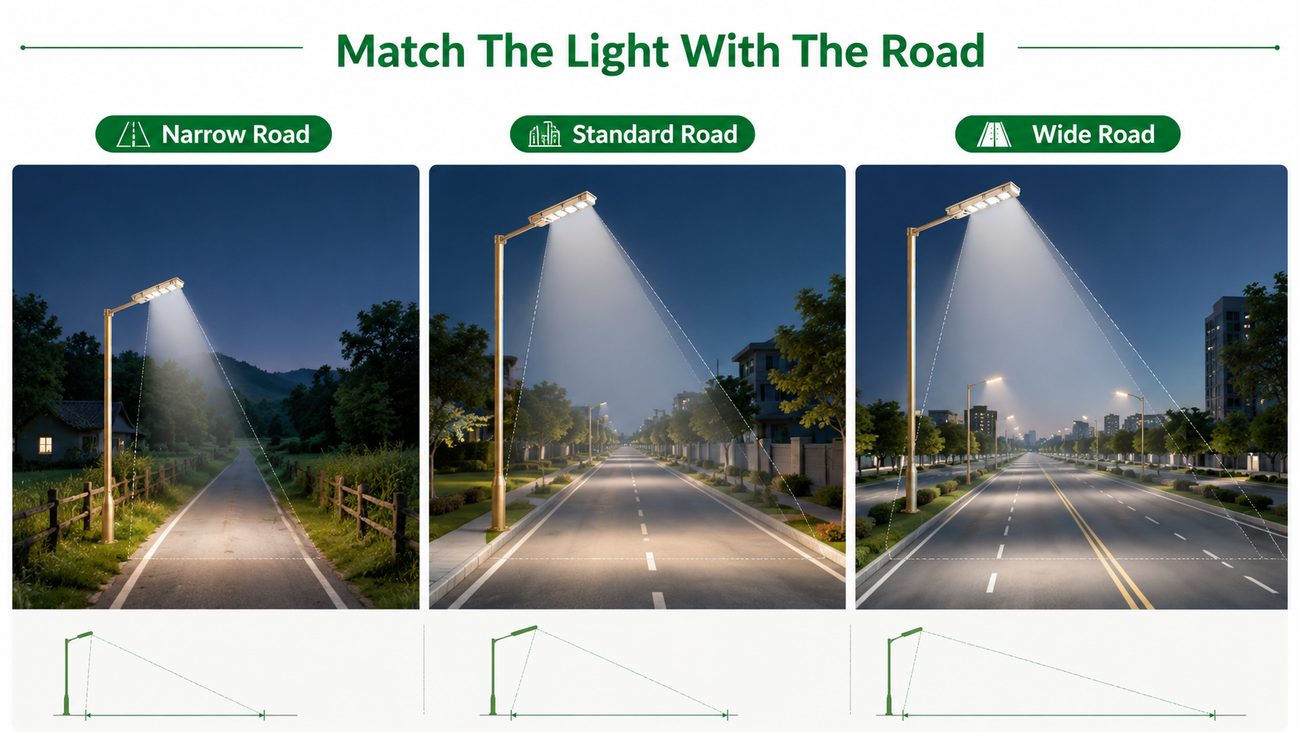
When mounted at 4 m for a roughly 3‑meter‑wide rural road with 15 m pole‑to‑pole spacing, light concentrates over the travelling zone, and continuous illumination can be achieved easily.
If the same lamp is raised to 6 m, serving a 6‑meter‑wide road with pole spacing extended to 20 m, the area to be illuminated grows substantially. Even without any change to the luminaire, heavier lighting stress occurs along road edges and between adjacent lamps.
Therefore, buyers should not merely ask “how many watts is this lamp”. It is essential to share the following site information with suppliers:
Mounting height, road width and planned pole spacing.

2. Wider roads cannot be addressed by simply raising pole height
Take a project of 20 lamps as an example:
For a 3‑meter‑wide road with 15 m pole spacing, the core goal is to maintain continuous illumination for this narrow roadway.
For a 6‑meter‑wide road with 20 m pole spacing, each luminaire must deliver broader transverse coverage and smoother light transition between units.
Under such circumstances, priority should be given to verifying the luminaire’s light‑distribution pattern, actual light output and correct lamp‑head aiming toward the roadway, instead of merely increasing pole height.
3. Confirm full‑set site parameters prior to procurement
Experienced project purchasers gather key site data before placing orders:
‑ Road width: e.g. 3 m, 4 m or 6 m
‑ Mounting height: e.g. 4 m, 5 m or 6 m
‑ Pole‑to‑pole spacing: e.g. 15 m, 18 m or 20 m
‑ Installation type: pole‑mounted or wall‑mounted
‑ Application scenario: rural road, residential community, factory compound or building perimeter
Pole‑mounted all‑in‑one solar street lights work best for roadways, parks and public passages. Wall‑mounted versions are suitable for boundary walls, courtyards, gateways and building peripheries.
The clearer these site parameters are, the more accurate the supplier’s configuration recommendation will be. This avoids on‑site issues such as improper mounting height, insufficient coverage or unsuitable installation methods after goods arrive.
Case scenarios above serve for illustration purposes only. Final solution shall be tailored to local site conditions.
